📞Customer Service: +86 13248368268 📧servicecenter@suzhoufrank.com one year replacement and warranty!

Colonoscopy Simulators: Features That Matter for Training
Colonoscopy simulator effectiveness depends on torque response, loop reduction realism, and anatomical accuracy. Compare features that matter for training.
MEDICAL TRAINING
Dr Qi Rui
3/7/20265 min read
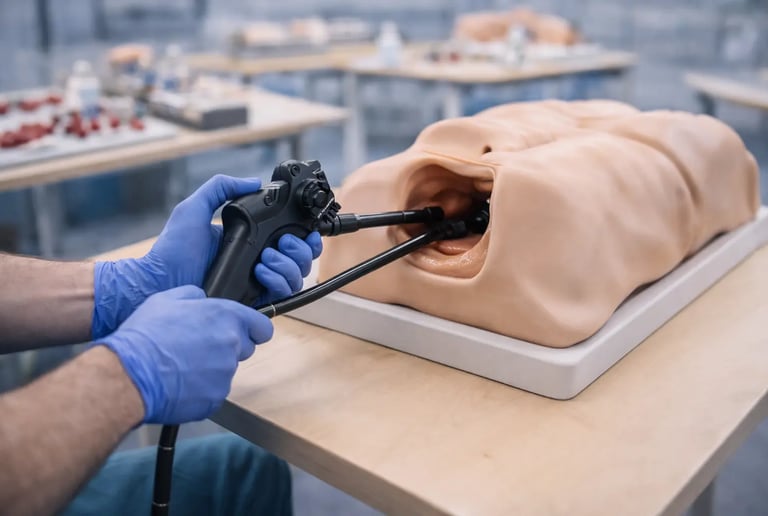
Mastering colonoscopy requires developing skills that cannot be acquired through observation alone. The procedure demands precise coordination between visual interpretation, manual dexterity, and tactile feedback, with the operator simultaneously managing scope navigation, loop formation, and patient comfort. As training programs increasingly incorporate simulation alongside clinical apprenticeship, understanding which colonoscopy simulator features contribute most significantly to skill development becomes essential for making informed equipment decisions.
This article examines the critical features that distinguish effective colonoscopy simulators from less capable training platforms, helping educators and program directors identify equipment that will meaningfully accelerate trainee progression.
Why Simulator Feature Quality Matters
Not all colonoscopy simulators deliver equivalent training value. Research published in Surgery Today found that when experienced colonoscopists evaluated simulator realism across multiple parameters, significant performance differences emerged between models, particularly in areas directly relevant to clinical skill transfer (Noda et al., 2017). Features rated as significantly more realistic in superior simulators included torque response, loop reduction behavior, and anatomical angulation at critical junctions.
These findings underscore an important principle: a colonoscopy simulator functions as an educational investment whose return depends substantially on how closely it replicates the challenges trainees will encounter with actual patients. Programs considering simulation equipment should evaluate specific features rather than relying solely on general product categories.
For foundational information on simulation principles across endoscopic disciplines, our complete guide to medical simulation in endoscopy and GI training provides comprehensive educational context.
Anatomical Accuracy and Structural Realism
The foundation of any effective colonoscopy simulator lies in its anatomical representation. Trainees must learn to navigate the same structural landmarks, flexures, and junctions they will encounter clinically.
Critical anatomical features include accurate representation of the rectosigmoid junction, where many novice difficulties begin. The angulation at this junction significantly affects scope passage technique. Similarly, the splenic and hepatic flexures present navigational challenges that require specific maneuvering skills. Simulators that accurately replicate the degree of angulation at these points prepare trainees for real procedural challenges.
The sigmoid colon presents particular training importance because its variable morphology creates the loop formations that novices must learn to recognize and resolve. Research has identified three common sigmoid configurations: short alpha loops, long alpha loops, and N loops, which together account for the vast majority of anatomical presentations. Quality simulators allow practice across multiple sigmoid configurations, building trainee adaptability.
Rectal anatomy also merits attention. The Houston's valves create specific visual landmarks and affect initial scope insertion. Simulators providing realistic rectal unit construction offer more authentic training experiences from the procedure's first moments.
Torque Response and Haptic Feedback
Beyond visual appearance, how a colonoscopy simulator responds to manipulation determines its training effectiveness. Torque response, meaning how the simulator reacts to clockwise and counter-clockwise rotational forces applied to the scope shaft, directly affects whether trainees develop appropriate technique.
The research comparing colonoscopy simulators specifically identified torque requirements as a feature showing statistically significant differences between models. Simulators requiring realistic rotational force help trainees develop the muscle memory and tactile judgment necessary for clinical colonoscopy. Those requiring insufficient torque may allow trainees to develop habits that fail under real procedural conditions.
Haptic feedback extends beyond rotation to include insertion resistance, the feel of scope movement through the colon, and tactile indicators of loop formation. A review in the World Journal of Gastroenterology notes that simulation training combining haptic realism with visual feedback helps trainees learn hand-eye coordination essential for endoscopic procedures (Hashimoto et al., 2022).
Virtual reality colonoscopy simulators typically incorporate electronic haptic systems that generate resistance feedback, while physical simulators achieve haptic realism through material properties and construction design. Both approaches can be effective when properly implemented.
Loop Formation and Reduction Training
Loop formation represents one of colonoscopy's most challenging aspects for novice endoscopists. The ability to recognize loop development, understand its anatomical basis, and apply appropriate reduction techniques distinguishes competent colonoscopists from those who struggle with completion rates and patient comfort.
Effective colonoscopy simulators must allow loops to form realistically during insertion and respond appropriately to standard reduction techniques. The research literature specifically highlights simulator response to loop reduction as a feature showing significant quality differences between models. Simulators where loops resolve through proper technique reinforce correct skill development, while those where loops resolve through unrealistic mechanisms may fail to prepare trainees adequately.
Physical simulators with transparent body construction offer unique advantages for loop training because both trainee and instructor can directly observe scope position, loop formation, and the effects of reduction maneuvers. This visual feedback accelerates learning by connecting tactile sensations with visible scope behavior.
Visual Feedback and Image Response
Colonoscopy requires continuous correlation between the endoscopic image and scope position within the colon. Quality simulators provide visual responses that accurately reflect steering maneuvers, advancing movements, and mucosal visualization.
The response of the visual image to steering maneuvers emerged as another significant differentiating feature in simulator comparisons. When trainees deflect the scope tip, the visual presentation should change in ways consistent with actual endoscopic behavior. This correlation helps develop the visual-spatial reasoning that experienced endoscopists apply intuitively.
Mucosal fold appearance and response to insufflation also contribute to training realism. While no simulator perfectly replicates living tissue appearance, those providing representative fold patterns and appropriate responses to air inflation better prepare trainees for mucosal inspection during actual procedures.
Procedural Modules and Training Progression
Beyond basic navigation, colonoscopy training encompasses therapeutic skills including polypectomy, biopsy, and hemostasis. Simulators supporting these additional procedures provide more comprehensive training platforms.
The Gastrointestinal Endoscopy Simulator addresses upper GI procedures while companion platforms focus on colonoscopic intervention. For programs emphasizing therapeutic technique development, the Gastrointestinal ESD Surgical Simulator enables practice of advanced dissection techniques in a controlled environment.
Virtual reality simulators often include structured training modules that progress from basic insertion skills through increasingly complex scenarios. These progressive curricula can support competency-based training approaches where trainees advance based on demonstrated skill rather than time-based metrics.
Integration with Broader Simulation Programs
Gastroenterology training rarely exists in isolation. Programs often train providers across multiple endoscopic disciplines, and simulation equipment supporting this broader scope provides efficiency advantages.
Bronchoscopy training shares fundamental endoscopic principles with colonoscopy, and dedicated platforms like the Ultrasound Bronchoscopy Simulator address airway-specific techniques. Urological and gynecological endoscopy similarly benefit from simulation, with platforms like the Urological Endoscopy Simulator and Hysteroscopy Simulator supporting skill development in these specialties.
Programs developing comprehensive simulation curricula can benefit from equipment compatibility and supplier consistency when building multi-specialty training capabilities.
Practical Considerations: Durability and Maintenance
Training simulators experience repeated use that places significant demands on materials and construction. Durability under intensive daily use directly affects long-term training costs and equipment availability.
Physical colonoscopy simulators require periodic replacement of consumable components including colon tubes and rectal units. Understanding replacement part availability, costs, and installation requirements helps programs plan maintenance budgets accurately. Water-resistant construction simplifies cleaning between uses, supporting infection control protocols in shared training environments.
Portability also merits consideration for programs conducting training across multiple sites or participating in educational conferences. Compact designs that travel easily extend simulation reach beyond fixed simulation centers.
Suzhou Frank Medical: Training Solutions for Endoscopy Programs
At Suzhou Frank Medical, we manufacture simulation equipment designed to support medical education programs across endoscopic specialties. Our products emphasize the anatomical accuracy and durability that effective training requires, with attention to the features research identifies as most important for skill development.
Our simulation portfolio spans gastrointestinal, bronchoscopy, urological, and gynecological training applications. For complete information on available training models, visit our endoscopic intervention training model catalog.
Programs evaluating colonoscopy simulator options or developing comprehensive simulation curricula can contact us for consultation and product information.
Selecting Equipment for Training Success
The features distinguishing effective colonoscopy simulators, including anatomical accuracy, realistic torque response, appropriate loop behavior, and authentic visual feedback, directly influence whether simulation time translates to clinical competence. Programs investing in simulation equipment should evaluate these specific characteristics rather than assuming all simulators within a category perform equivalently.
Quality simulation complements rather than replaces supervised clinical training, but the preparation simulators provide can accelerate early learning curves and build foundational skills that support faster clinical progression.
© 2025. All rights reserved.
About Us
Introduction
Development
Cooperation
Service
Main Products
Medical Grade Monitor
No 15, Jinyang road KunshanSuzhou, Jiangsu, China