📞Customer Service: +86 13248368268 📧servicecenter@suzhoufrank.com one year replacement and warranty!

Competency Training in Endoscopy: Milestones and Checklists
Discover how competency training in endoscopy uses milestones, checklists, and simulation to document trainee progression toward independent practice.
MEDICAL TRAINING
Dr Qi Rui
1/26/20266 min read
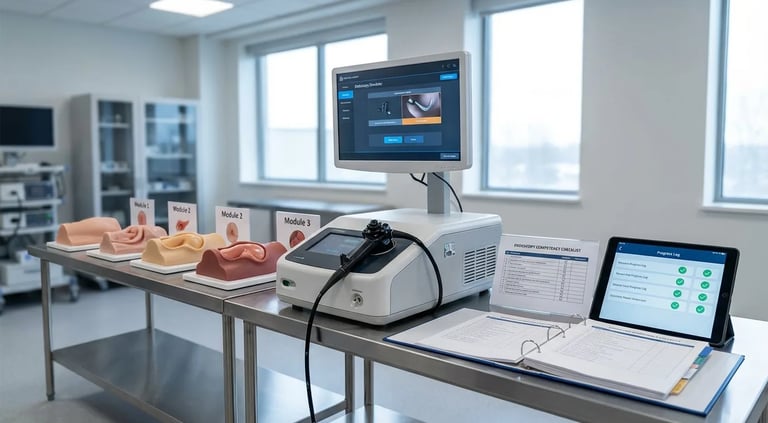
Medical education has undergone a fundamental shift. The traditional model of counting procedures and logging hours has given way to something more meaningful: demonstrating actual ability. Competency training focuses on what trainees can do rather than how long they have been doing it. In endoscopy, this approach ensures that graduates possess the skills needed for independent practice before they ever work without supervision.
This guide explains how competency-based training works in endoscopy, covering the milestone frameworks that define progression, the checklists that measure performance, and the role simulation plays in documenting readiness for unsupervised practice.
The Shift from Numbers to Competence
For decades, endoscopy training relied on volume thresholds. Complete a certain number of colonoscopies and you were deemed competent. The problem with this approach is that trainees learn at different rates. Some achieve proficiency after 150 procedures. Others need 300 or more. A numbers-based system either holds fast learners back or pushes slow learners forward before they are ready.
Competency-based medical education addresses this by measuring what trainees can actually do. According to the ACGME Gastroenterology Milestones, training programs must assess fellows' development across defined competency domains and report their progress semi-annually. The milestones provide a developmental framework that tracks progression from novice to expert, independent of procedure counts or time in training.
This shift carries significant implications for training programs. It requires structured assessment systems, documented performance metrics, and clear criteria for advancement. It also requires opportunities for trainees to develop and demonstrate skills in controlled environments before applying them to patient care.
Understanding the Milestone Framework
The ACGME organizes competency training around six core domains: patient care, medical knowledge, systems-based practice, practice-based learning, professionalism, and interpersonal communication. Within each domain, specific milestones describe expected abilities at five progressive levels. Level 1 represents a beginning trainee who needs significant assistance. Level 4 represents readiness for unsupervised practice. Level 5 represents expert performance beyond graduation expectations.
For endoscopic procedures specifically, the milestones address both cognitive and technical components. Cognitive milestones cover the ability to select appropriate procedures, recognize normal and abnormal findings, and determine subsequent care plans. A trainee at Level 1 can identify immediate interventions with significant assistance. By Level 4, that same trainee independently selects appropriate interventions while recognizing personal limitations.
Technical milestones address the hands-on aspects of procedural performance. Early milestones involve performing portions of procedures with significant assistance. Progression moves through performing complete procedures with decreasing supervision until the trainee can independently perform standard therapeutic interventions. The framework acknowledges that progression is not always linear. Trainees may advance quickly in some areas while needing more time in others.
Procedural Checklists in Endoscopy Training
Milestones provide the developmental framework. Checklists translate that framework into observable, measurable performance criteria. A well-designed procedural checklist breaks complex endoscopic tasks into discrete steps that assessors can evaluate objectively.
For upper endoscopy, a checklist might include pre-procedure elements like patient positioning and equipment verification, procedural elements covering scope insertion technique and systematic examination, and post-procedure elements addressing documentation and patient recovery assessment.
Checklists standardize evaluation across different assessors and training sites. They provide trainees with clear expectations and generate documentation for tracking progression. When a trainee consistently misses the same items, that pattern reveals specific skills requiring targeted practice. Effective assessment combines checklists with global rating scales that evaluate dimensions like efficiency, tissue handling, and patient comfort.
Simulation's Role in Competency Documentation
Clinical training alone cannot meet the documentation demands of competency-based education. Patient encounters vary in complexity and findings. Supervision intensity fluctuates based on case volume and faculty availability. Some skills, particularly management of complications, occur too rarely to ensure all trainees receive adequate exposure.
Simulation fills these gaps by creating standardized conditions where all trainees face equivalent challenges. When every trainee navigates the same simulated anatomy and encounters the same pathology, performance differences reflect actual competence rather than case variation. Simulation also allows assessment of skills that would be unsafe or impractical to evaluate on real patients during training.
The GI Endoscopy Simulator supports early milestone achievement by providing consistent practice environments for basic scope manipulation and navigation. Trainees can develop fundamental skills and receive structured feedback before their first patient encounters. As trainees progress, the GI ESD Surgical Simulator enables practice of advanced therapeutic techniques that require precise dissection skills.
Simulation-based assessment generates objective data that complements clinical evaluations. Procedure completion times, scope navigation metrics, and complication management responses all provide documentation that supports milestone advancement decisions.
Building a Competency Training Curriculum
Effective competency training requires intentional curriculum design. Programs must map specific learning activities to milestone objectives, ensuring trainees have opportunities to develop and demonstrate required abilities.
Early in training, the curriculum emphasizes foundational skills. Trainees learn scope handling, basic navigation, and recognition of normal anatomy. Simulation plays a heavy role at this stage, allowing unlimited practice without patient risk.
Mid-training shifts toward integration and independence. Trainees perform complete procedures with decreasing assistance and begin managing straightforward therapeutic situations. Late training prepares for unsupervised practice, with trainees managing complex cases and demonstrating not just technical proficiency but clinical judgment. By graduation, they should function at Level 4 across all relevant milestone domains.
Assessment Tools and Documentation
Competency training demands robust assessment systems. Programs need tools that capture performance data across multiple evaluators and settings, then aggregate that data into meaningful progress reports.
The Assessment of Competency in Endoscopy tools developed by ASGE provide structured evaluation frameworks for colonoscopy and upper endoscopy. These instruments assess both cognitive and motor skills using anchored rating scales. Direct observation remains essential, with faculty completing evaluation forms during or immediately after supervised procedures. Clear behavioral anchors help ensure different evaluators apply similar standards.
Simulation assessments add standardized data points. Because simulation conditions are controlled, performance metrics can be compared across trainees and over time, providing objective evidence of skill development.
Competency Across Endoscopic Specialties
While gastroenterology provides the most developed competency frameworks, similar principles apply across all endoscopic specialties. Each field has core procedures that trainees must master and milestones that define progression toward independent practice.
Bronchoscopy training addresses airway navigation, sampling techniques, and recognition of pulmonary pathology. Simulators like the Bronchoscopy Simulator Type A, Type B, and Type C support skill development across different complexity levels. For procedures combining endoscopy with ultrasound imaging, the Ultrasound Bronchoscopy Simulator addresses the dual competencies required.
Urological endoscopy presents unique challenges due to delicate anatomy and limited working space. The Urological Endoscopy Simulator supports competency development in cystoscopy and ureteroscopy. Gynecological procedures have their own requirements addressed by the Hysteroscopy Simulator.
Laparoscopic skills underpin many advanced endoscopic techniques. The Laparoscopy Simulator helps trainees develop camera navigation and instrument handling abilities that transfer across minimally invasive procedures. For specialized spine procedures, the Intervertebral Foramen Endoscope Simulator addresses the specific competencies required for endoscopic spine surgery.
Entrustable Professional Activities
Beyond milestones, competency training increasingly incorporates Entrustable Professional Activities. EPAs represent discrete clinical tasks that supervisors can entrust trainees to perform with varying levels of independence. Rather than abstract competency domains, EPAs describe actual work that endoscopists do.
An EPA for diagnostic upper endoscopy includes everything from patient assessment through procedure completion to documentation and follow-up planning. The question becomes: can this trainee be trusted to perform this complete activity without direct supervision? EPAs complement milestones by connecting competency assessment to real clinical work and focusing training on achieving true independence.
Program Implementation Challenges
Transitioning to competency-based training requires significant program investment. Faculty need training in assessment methods and milestone interpretation. Systems must capture and aggregate evaluation data from multiple sources.
Clinical Competency Committees play a central role, reviewing accumulated evidence to make decisions about trainee progression. Committee members need shared understanding of what performance looks like at each level. Remediation pathways must exist for trainees who do not progress as expected, with structured approaches to identify deficits and provide targeted intervention.
For comprehensive guidance on building simulation into endoscopy training programs, see our complete guide to medical simulation in endoscopy and GI training.
Competency Training Equipment from Suzhou Frank Medical
At Suzhou Frank Medical, we manufacture simulation equipment designed to support competency-based endoscopy training. Our simulators provide the consistent, repeatable practice environments that meaningful skill assessment requires. When programs need to document trainee progression through defined milestones, quality simulation creates the standardized conditions that make objective evaluation possible.
Programs building or enhancing their competency training systems can explore our complete endoscopic intervention training model catalog. For questions about specific training applications or to discuss how our simulators might support your program's competency assessment needs, please contact us directly.
The Future of Competency Training
Competency-based education continues to evolve. Assessment tools become more sophisticated. Simulation technology enables increasingly realistic skill evaluation. The fundamental premise remains constant: what matters is what trainees can do, not how long they have been training. Programs that invest in robust milestone assessment, comprehensive checklists, and quality simulation prepare their trainees not just to complete training, but to provide excellent patient care from their first day of unsupervised practice.
© 2025. All rights reserved.
About Us
Introduction
Development
Cooperation
Service
Main Products
Medical Grade Monitor
No 15, Jinyang road KunshanSuzhou, Jiangsu, China