📞Customer Service: +86 13248368268 📧servicecenter@suzhoufrank.com one year replacement and warranty!

Diagnostic Medical Imaging and Clinical Insight: How It Helps in Decisions
Diagnostic medical imaging explained: how images become clinical insight. Covers acquisition , interpretation , reporting and integrating findings with judgment.
MEDICAL IMAGING
Dr Qi Rui
12/29/20255 min read
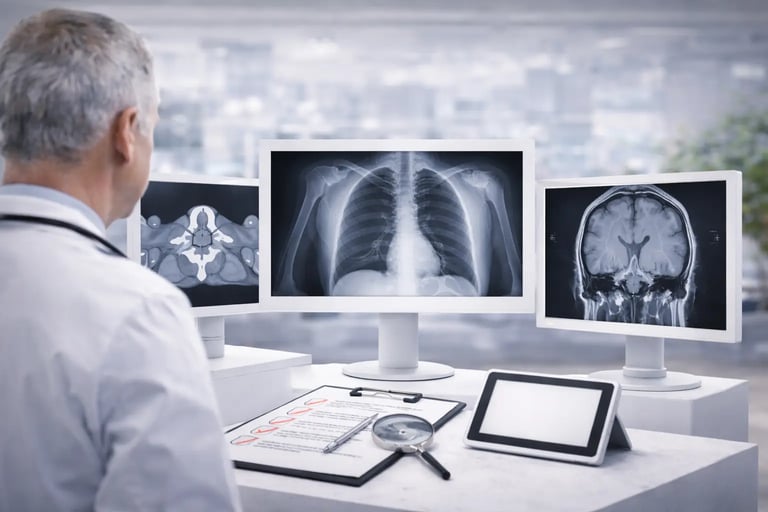
Diagnostic medical imaging has become inseparable from modern clinical decision-making. What physicians once determined through physical examination and patient history alone now integrates visual evidence from inside the body. Imaging reveals what hands cannot feel and eyes cannot see , transforming uncertainty into actionable insight.
But images alone don't make diagnoses. The pathway from image acquisition to clinical decision involves interpretation , integration and judgment. Understanding how diagnostic imaging contributes to clinical insight helps healthcare teams maximize its value in patient care.
The Role of Diagnostic Medical Imaging in Modern Medicine
Diagnostic medical imaging encompasses all imaging modalities used to visualize internal anatomy and physiology for clinical purposes. X-ray , CT , MRI , ultrasound , nuclear medicine and other technologies each reveal different aspects of body structure and function.
The fundamental purpose remains constant across modalities: provide visual information that supports clinical decisions. Whether confirming a suspected diagnosis , ruling out concerning pathology , staging disease extent or monitoring treatment response , diagnostic imaging answers questions that guide patient management.
According to the American College of Radiology , appropriate use of diagnostic imaging requires matching the right study to the clinical question. Their Appropriateness Criteria provide evidence-based guidance on imaging selection across hundreds of clinical scenarios. This framework ensures diagnostic medical imaging serves its intended purpose: generating actionable clinical insight rather than unnecessary images.
The value of imaging lies not in the images themselves but in the insight they provide. A scan that doesn't change management adds cost without benefit. A well-chosen study that clarifies diagnosis or guides treatment delivers genuine clinical value.
From Image Acquisition to Clinical Insight
The journey from imaging order to clinical decision involves multiple steps. Each step contributes to transforming raw images into insight medical imaging teams and clinicians can act upon.
Image Acquisition
Quality insight begins with quality images. Acquisition protocols must be appropriate for the clinical question. Technical parameters must optimize visualization of relevant anatomy. Patient preparation and positioning must support diagnostic image quality.
Modern imaging equipment offers sophisticated capabilities , but technology alone doesn't ensure useful images. Trained technologists who understand both equipment operation and clinical objectives are essential. Understanding advanced medical imaging technology helps facilities appreciate how acquisition quality affects downstream interpretation.
Image Processing
Raw imaging data undergoes processing before interpretation. Reconstruction algorithms convert CT and MRI acquisitions into viewable images. Post-processing techniques enhance visualization of specific findings. 3D reconstructions , multiplanar reformats and other manipulations help radiologists evaluate complex anatomy.
Processing can reveal or obscure clinical information. Appropriate techniques make pathology visible. Inappropriate processing may create artifacts or hide significant findings. Technical expertise in image processing directly affects diagnostic yield.
Interpretation
Radiologists and other imaging specialists interpret processed images , identifying normal anatomy , pathological findings and incidental discoveries. Interpretation requires pattern recognition developed through years of training , knowledge of disease manifestations and understanding of clinical context.
The interpretive process transforms visual patterns into diagnostic possibilities. A shadow becomes a nodule. A nodule's characteristics suggest benign or malignant etiology. Location , size , shape , density and enhancement patterns all contribute to characterization. Experience and expertise determine how accurately these visual features translate to diagnostic insight.
Reporting
Interpretation findings are communicated through structured reports. Effective reporting conveys not just what was seen but what it means clinically. Reports should answer the clinical question that prompted the study , describe significant findings clearly and provide actionable recommendations when appropriate.
The Radiological Society of North America has developed reporting standards and templates that improve communication between radiologists and referring clinicians. Standardized reporting ensures insight medical imaging professionals develop reaches the clinical teams who need it in useful form.
How Imaging Insight Supports Clinical Decisions
Diagnostic medical imaging contributes to clinical decisions in several distinct ways. Each represents a different type of insight that imaging provides.
Diagnosis Confirmation
When clinical findings suggest a specific diagnosis , imaging can confirm or refute the suspicion. A patient with right lower quadrant pain and elevated white count may undergo CT to confirm appendicitis. Positive findings support surgical intervention. Negative findings redirect clinical thinking.
This confirmatory role provides insight that increases diagnostic confidence. Clinicians move from suspicion to certainty , enabling definitive treatment decisions.
Differential Diagnosis Narrowing
Many clinical presentations have multiple possible causes. Imaging helps narrow the differential by revealing findings consistent with some diagnoses and inconsistent with others.
A patient with jaundice might have biliary obstruction , hepatocellular disease or hemolysis. Imaging that shows dilated bile ducts and a pancreatic mass dramatically narrows possibilities. This insight focuses subsequent workup and guides management even before definitive tissue diagnosis.
Disease Staging
Once diagnosis is established , imaging often determines disease extent. Cancer staging relies heavily on diagnostic medical imaging to assess primary tumor size , lymph node involvement and distant metastases.
Staging insight directly affects treatment planning. Early-stage disease may be curable with local therapy. Advanced disease may require systemic treatment. Imaging findings guide these consequential decisions.
Treatment Monitoring
Imaging performed during treatment assesses response. Tumors shrinking on chemotherapy indicate effective therapy. Stable or growing tumors suggest treatment failure. This insight guides decisions to continue , modify or abandon treatment approaches.
Response assessment requires comparison with prior imaging. Consistent technique and interpretation enable meaningful comparison that informs ongoing management.
Screening and Early Detection
Some diagnostic imaging aims to detect disease before symptoms develop. Mammography screening for breast cancer , low-dose CT screening for lung cancer in high-risk populations and other screening programs use imaging to identify early-stage disease when treatment is most effective.
Screening insight differs from diagnostic insight. Screening seeks to identify unsuspected disease in asymptomatic populations. The insight gained is the knowledge that concerning findings exist and warrant further evaluation.
Integrating Imaging Insight With Clinical Judgment
Imaging findings rarely dictate clinical decisions in isolation. Insight medical imaging provides combines with other clinical information to guide patient care.
Clinical Context Matters
The same imaging finding may have different significance in different clinical contexts. A small pulmonary nodule in a young nonsmoker has different implications than the same finding in an elderly patient with smoking history and weight loss.
Radiologists interpret more accurately when they understand clinical context. Referring clinicians apply imaging findings more appropriately when they understand their limitations. Bidirectional communication improves the value of diagnostic medical imaging.
Multidisciplinary Integration
Complex cases benefit from multidisciplinary discussion. Tumor boards , case conferences and collaborative consultations bring together imaging findings , pathology results , clinical assessments and treatment expertise.
These forums integrate insight from multiple sources into coherent management plans. Diagnostic imaging contributes essential visual information , but optimal decisions emerge from synthesis across disciplines.
Uncertainty and Limitations
Imaging doesn't always provide definitive answers. Some findings are indeterminate. Some pathology is invisible to current technology. Some clinical questions can't be answered by imaging alone.
Recognizing these limitations is itself a form of insight. Understanding what imaging can and cannot reveal helps clinicians calibrate confidence appropriately and pursue additional information when needed.
Maximizing the Value of Diagnostic Medical Imaging
Healthcare facilities can enhance the clinical insight derived from diagnostic imaging through several approaches.
Appropriate Utilization
Ordering the right study for the clinical question maximizes diagnostic yield. Clinical decision support tools and appropriateness guidelines help match imaging to clinical needs.
Quality Assurance
Consistent image quality supports reliable interpretation. Equipment maintenance , protocol optimization and technologist training all contribute to imaging quality that enables accurate insight.
Effective Communication
Clear , timely reporting ensures imaging insight reaches clinical teams when it matters. Structured reports , critical result notification systems and direct clinician-radiologist communication enhance information flow.
Technology Investment
Modern imaging and display technology reveals findings that older equipment might miss. Facilities that invest in quality imaging systems and medical-grade display solutions , like those offered by Suzhou Frank Medical , provide their teams with the visual tools needed to extract maximum insight from every study.
Conclusion
Diagnostic medical imaging transforms clinical uncertainty into actionable insight. From initial acquisition through interpretation and reporting , each step in the imaging pathway contributes to understanding that guides patient care. The insight medical imaging provides becomes most valuable when integrated thoughtfully with clinical judgment , multidisciplinary expertise and recognition of both capabilities and limitations.
When imaging is used appropriately , interpreted expertly and communicated effectively , it elevates clinical decision-making in ways that directly benefit patients.
© 2025. All rights reserved.
About Us
Introduction
Development
Cooperation
Service
Main Products
Medical Grade Monitor
No 15, Jinyang road KunshanSuzhou, Jiangsu, China