📞Customer Service: +86 13248368268 📧servicecenter@suzhoufrank.com one year replacement and warranty!

Endoscopy Training: How Simulators Improve Skills Safely
Endoscopy training guide covering how simulators improve skills safely. Understand the role of simulation in building competence before patient procedures.
MEDICAL TRAINING
Dr Qi Rui
1/20/20266 min read
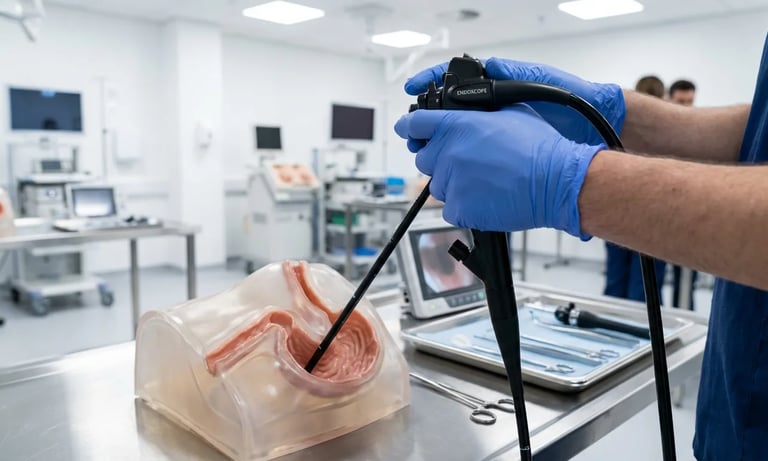
Learning to perform endoscopic procedures requires more than book knowledge. Trainees need to develop hand-eye coordination, spatial awareness, and the muscle memory required to navigate delicate anatomical structures without causing harm. For decades , endoscopy training relied almost entirely on an apprenticeship model where beginners learned by working on actual patients under supervision. That approach worked , but it came with limitations. Simulators have changed the equation. They give trainees a safe environment to develop foundational skills , make mistakes , learn from feedback , and build confidence before they ever touch a patient.
This guide covers how modern endoscopy training programs are structured and how simulators fit into the learning process.
The Traditional Apprenticeship Model
Historically , endoscopy training followed a simple pattern. New fellows watched experienced endoscopists perform procedures. Then they gradually took over portions of cases under direct supervision. Eventually they performed complete procedures independently. This "see one , do one , teach one" approach exposed trainees to real clinical situations and taught them to manage actual patient interactions.
But the apprenticeship model has problems. Patient safety depends on how quickly the supervising physician takes back control when something goes wrong. Training opportunities are limited by case availability. And fellows progress at different rates , meaning some complete the recommended number of procedures without truly achieving competence.
Professional organizations have recognized these limitations. The American Society for Gastrointestinal Endoscopy recommends that trainees complete minimum procedure numbers before competency can be assessed. For colonoscopy that threshold is currently 275 procedures. For upper endoscopy it's 130 procedures. But numbers alone don't guarantee skill. Some trainees need far more practice , and increasingly training programs are shifting toward competency-based assessments rather than simple procedure counts.
Why Simulation Matters in Endoscopy Training
Simulation-based training addresses several problems with traditional apprenticeship learning. First , it removes patients from the early learning curve. Beginners can practice basic scope manipulation , navigation , and even therapeutic techniques without any risk of patient harm. Second , simulation allows for repetitive practice. A trainee struggling with a particular maneuver can repeat it dozens of times in a single session. That kind of focused repetition isn't possible when every case involves a real patient with their own clinical needs.
Third , simulators provide immediate feedback. Many systems track metrics like distance advanced , wall contact , time to completion , and loop formation. Trainees see exactly where their performance falls short. And they can work on specific deficiencies rather than simply hoping improvement happens through volume alone.
Research supports simulation effectiveness. According to evidence reviewed by the American Society for Gastrointestinal Endoscopy , simulation-based training improves technical skills and can accelerate the early learning curve. Studies using virtual reality simulators have demonstrated that trainees who practice on simulators before working on patients perform better during their first clinical procedures compared to those who receive conventional training only.
How Training Programs Use Simulators
Most endoscopy training programs now integrate simulation at specific points in the curriculum. The typical approach begins with simulation during the preclinical phase. Before trainees perform any procedures on patients , they spend time on simulators learning basic scope handling. This includes understanding the controls , developing coordination between hand movements and scope tip deflection , and learning to navigate through simulated anatomy.
Once trainees demonstrate basic competence on simulators , they transition to supervised clinical procedures. But simulation doesn't stop there. Many programs bring trainees back to simulators for specific skills. A fellow who struggles with loop reduction during colonoscopy might spend extra time practicing that specific technique. Someone preparing for their first polypectomy can rehearse the motions on a simulated polyp before removing a real one.
For example , gastrointestinal endoscopy simulators like the GI Endoscopy Simulator allow trainees to practice upper and lower endoscopy navigation in a realistic environment. And when trainees progress to advanced therapeutic techniques , specialized models such as the GI ESD Surgical Simulator provide practice opportunities for complex procedures like endoscopic submucosal dissection.
Advanced fellowship programs use simulation extensively. Trainees learning ERCP , endoscopic ultrasound , or other complex procedures benefit from simulation before attempting these techniques on patients. The stakes are higher with advanced procedures , making simulation practice even more valuable.
Types of Simulators in Endoscopy Training
Training programs use several simulator categories depending on their goals and resources.
Mechanical simulators use physical models that replicate anatomical structures. Trainees insert actual endoscopes and practice navigation through silicone or rubber pathways. These models provide realistic tactile feedback. They're durable , relatively affordable , and don't require computer systems. Many programs use mechanical models for initial skills training before progressing to more complex systems.
Virtual reality simulators use computer-generated environments displayed on screens. Trainees manipulate modified endoscope handles that send input to the software. The computer tracks movements and provides performance metrics. VR systems can simulate a wide variety of pathology and scenarios that might be rare in clinical practice. However they typically cost more than mechanical models and the haptic feedback doesn't perfectly match real tissue.
Hybrid simulators combine physical models with electronic feedback systems. These attempt to provide realistic tactile sensation while also capturing performance data for assessment.
Ex vivo animal tissue models use preserved animal organs. These provide the most realistic tissue handling experience but require ongoing procurement of specimens and proper handling protocols.
The best approach often involves multiple simulator types. Trainees might begin with mechanical models , progress to VR systems for more complex scenarios , and use animal tissue models for advanced therapeutic techniques.
Simulation Across Endoscopy Specialties
Endoscopy training extends beyond gastroenterology. Multiple medical specialties require endoscopic skills , and simulation supports training across all of them.
In pulmonology , bronchoscopy training benefits significantly from simulation. Trainees must learn to navigate the airway's branching structure and identify landmarks. Bronchoscopy simulators like the Bronchoscopy Simulator Type A , Type B , and Type C provide anatomically accurate airways for navigation practice. For trainees learning endobronchial ultrasound , the Ultrasound Bronchoscopy Simulator adds imaging interpretation to the skill set.
Urological endoscopy presents unique challenges. Cystoscopy and ureteroscopy require navigation through smaller caliber structures. The Urological Endoscopy Simulator allows trainees to practice these techniques safely. Prostate procedures including transrectal ultrasound can be practiced on dedicated models like the Prostate Ultrasound Simulator.
Gynecological procedures also benefit from simulation. Hysteroscopy requires precise scope manipulation within a confined space. The Hysteroscopy Simulator provides realistic practice for intrauterine navigation and therapeutic interventions.
Laparoscopic surgery shares many skills with endoscopy. The Laparoscopy Simulator helps surgical trainees develop instrument handling and camera navigation abilities.
And in orthopedic spine surgery , endoscopic approaches require their own specialized training. The Intervertebral Foramen Endoscope Simulator supports this emerging field.
The Evidence for Simulation Training
Research consistently demonstrates that simulation improves trainee performance. According to a review published in World Journal of Gastroenterology , simulation-based training in gastrointestinal endoscopy improves learning outcomes and performance in clinical settings. The researchers identified deliberate practice with mastery learning , structured feedback , and contextual learning as key elements that maximize simulation benefits.
Multiple randomized controlled trials have compared simulation-trained learners with conventionally trained learners. Generally , trainees who receive simulation practice before clinical work perform better during initial patient procedures. They complete colonoscopies faster , cause less patient discomfort , and achieve cecal intubation more reliably.
The benefits appear strongest during the early learning curve. Simulation helps trainees get past the initial awkward phase more quickly. Once trainees reach intermediate skill levels , the advantage of simulation over conventional training becomes less pronounced. But that early-phase benefit matters. Patients examined by complete beginners benefit when those beginners have already developed basic competence on simulators.
Building Confidence Through Safe Practice
Beyond measurable skills , simulation builds trainee confidence. Performing an endoscopic procedure for the first time on a real patient creates anxiety. That anxiety can impair performance. Trainees who have already successfully completed similar procedures on simulators approach their first patient cases with more confidence. They know how the scope handles. They've experienced what it feels like to navigate past the cricopharyngeus or around the splenic flexure. The novelty is reduced , allowing them to focus on the patient rather than basic mechanics.
Simulation also allows trainees to experience complications safely. A simulator can present bleeding , perforation , or other emergencies. Trainees practice their response without actual patient consequences. When these situations arise clinically , they've already rehearsed the management steps.
Training Products from Suzhou Frank Medical
At Suzhou Frank Medical , we provide a comprehensive range of endoscopy training simulators designed to support medical education programs worldwide. Our models cover gastrointestinal , bronchoscopic , urological , gynecological , and laparoscopic training needs. We design our simulators to provide realistic anatomical structures , durable construction , and practical functionality for intensive training use.
Whether you're establishing a new simulation center or expanding an existing training program , we offer solutions across multiple specialties and complexity levels. You can browse our complete selection of endoscopic intervention training models to find products that match your program's requirements. For specific questions about our simulators or to discuss your training needs , please contact us directly.
Moving Forward with Simulation-Enhanced Training
Endoscopy training continues to evolve. The shift from numbers-based to competency-based assessment demands better training tools. Simulators provide the controlled environment where trainees can develop skills , receive feedback , and achieve competence before patient contact. They complement rather than replace clinical training , creating a more complete educational experience.
© 2025. All rights reserved.
About Us
Introduction
Development
Cooperation
Service
Main Products
Medical Grade Monitor
No 15, Jinyang road KunshanSuzhou, Jiangsu, China