📞Customer Service: +86 13248368268 📧servicecenter@suzhoufrank.com one year replacement and warranty!

Gastroscopy vs Endoscopy: What’s the Difference?
Gastroscopy vs endoscopy explained. Understand the categorical relationship , regional terminology differences and how to use these terms precisely in clinic.
ENDOSCOPY
Dr Qi Rui
1/8/20266 min read
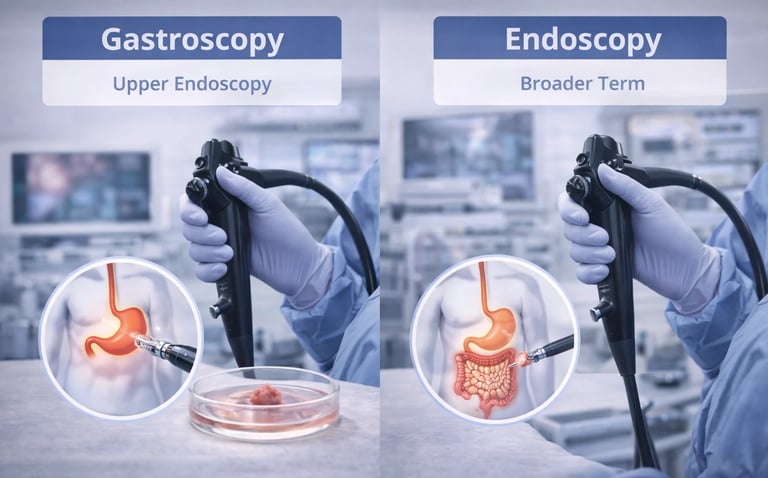
Medical terminology can confuse even diligent students. You'll hear attending physicians order a "gastroscopy" one day and an "upper endoscopy" the next , seemingly for identical procedures. Textbooks use "esophagogastroduodenoscopy" while clinic schedules simply say "EGD." Are these different procedures or different names for the same thing?
Understanding the gastroscopy vs endoscopy distinction matters for clear clinical communication. This guide clarifies the terminology , explains how these terms function in different clinical contexts and provides the framework medical students need to use these words precisely.
The Core Distinction
The confusion around gastroscopy vs endoscopy stems from a simple categorical relationship that isn't always made explicit.
Endoscopy is the broad category. It refers to any procedure using an endoscope to visualize internal body structures. The term derives from Greek: "endo" (within) and "skopein" (to look). Endoscopy encompasses dozens of distinct procedures across multiple specialties. Gastroscopy , on the other hand , is a specific type of endoscopy. It examines the stomach specifically , though in common usage it typically includes the esophagus and duodenum as well. Gastroscopy falls under the endoscopy umbrella the way cardiology falls under internal medicine.
This categorical relationship explains why both terms might describe what appears to be the same procedure. Saying a patient underwent "endoscopy" is technically correct but imprecise. Saying they underwent "gastroscopy" specifies which endoscopic procedure was performed.
For foundational understanding of endoscopic procedures generally , reviewing what endoscopy involves provides essential context before exploring specific terminology distinctions.
Endoscopy as an Umbrella Term
Endoscopy as a category includes any procedure where a flexible or rigid scope allows direct visualization of internal structures. The World Gastroenterology Organisation recognizes endoscopy as encompassing procedures across the entire gastrointestinal tract and beyond.
Within gastrointestinal medicine alone , endoscopy includes upper endoscopy examining the esophagus , stomach and duodenum. It includes colonoscopy for the entire colon and terminal ileum. Sigmoidoscopy examines the rectum and sigmoid colon. Enteroscopy reaches the small bowel beyond where standard upper endoscopy can go. Capsule endoscopy uses a swallowed camera for small bowel visualization. ERCP accesses biliary and pancreatic ducts. Endoscopic ultrasound combines GI tract visualization with ultrasound imaging of surrounding structures.
Beyond gastroenterology , endoscopy extends to bronchoscopy for airways and lungs , cystoscopy for bladder and urethra , hysteroscopy for the uterine cavity , arthroscopy for joint spaces , laparoscopy for the abdominal cavity , thoracoscopy for the chest cavity and laryngoscopy for the larynx and vocal cords.
This diversity illustrates why "endoscopy" alone lacks specificity. When a gastroenterologist says "endoscopy" they typically mean upper GI endoscopy. When a pulmonologist says it , they likely mean bronchoscopy. Context determines meaning , but precision requires specific terminology.
Gastroscopy and Its Synonyms
Gastroscopy technically means examination of the stomach , from Greek "gaster" for stomach. However , clinical usage has evolved beyond this literal definition. In practice , gastroscopy typically refers to examination of the upper gastrointestinal tract: esophagus , stomach and duodenum. The procedure passes a flexible endoscope through the mouth , down the esophagus , into the stomach and through the pylorus into the duodenal bulb and descending duodenum.
This creates a semantic oddity. A procedure called "gastroscopy" examines considerably more than just the stomach. The term persists because the stomach represents the primary target for many indications , even though the scope traverses other structures.
EGD , or esophagogastroduodenoscopy , represents the most anatomically precise terminology. The compound word explicitly names all three regions examined: esophagus , stomach (gastro) and duodenum. The American College of Gastroenterology uses EGD as the standard term in clinical guidelines and patient education materials. This precision eliminates ambiguity about which structures the procedure examines.
Medical students should recognize all variants as describing the same procedure: EGD in formal documentation , esophagogastroduodenoscopy as the full technical term , upper endoscopy in common American usage , upper GI endoscopy as an explicit but longer form , gastroscopy in common British and European usage , OGD (oesophagogastroduodenoscopy) as the British spelling variant , and "upper scope" as informal clinical shorthand. Facility preferences , regional conventions and individual physician habits determine which term appears in any given context.
Regional and Contextual Variation
The gastroscopy vs endoscopy distinction carries geographic dimensions that internationally mobile students should recognize. British medical tradition favors "gastroscopy" and "OGD." The British Society of Gastroenterology uses these terms in clinical guidelines. Students training in UK-influenced systems encounter gastroscopy as the default term. American practice prefers "upper endoscopy" and "EGD" with the spelling "esophago-" rather than "oesophago-." European gastroenterology literature mixes conventions depending on national traditions and whether publications follow British or American English.
Clinical context also shapes terminology. Gastroenterologists performing upper and lower GI endoscopy routinely often let context clarify meaning. "The patient needs endoscopy for dysphagia" clearly implies upper endoscopy. "Endoscopy for rectal bleeding" implies colonoscopy. Within GI divisions , "scope" often substitutes for endoscopy entirely , with "upper scope" and "lower scope" distinguishing the procedures efficiently if imprecisely.
Surgeons use endoscopy differently. General surgeons may perform diagnostic upper endoscopy but more commonly reference laparoscopy in their daily work. "Endoscopic approach" in surgical contexts often means laparoscopic or thoracoscopic rather than luminal GI endoscopy. Primary care physicians refer patients for endoscopic procedures using patient-friendly terms like "stomach scope" or "camera test" alongside more formal terminology.
Documentation requires precision regardless of verbal shortcuts. Procedure notes specify "EGD" or "esophagogastroduodenoscopy" rather than ambiguous terms. Billing codes distinguish between upper endoscopy , colonoscopy and other specific procedures. The informal shortcuts acceptable in conversation become problematic in written records.
Practical Applications for Medical Students
Understanding gastroscopy vs endoscopy terminology translates into practical clinical skills that will serve you throughout training and practice.
When taking histories and patients mention they've had "a scope" or "stomach test" , clarifying questions determine exactly which procedure they underwent. Asking whether the scope went through their mouth or bottom distinguishes upper from lower. Confirming whether doctors looked at their stomach or colon identifies the target organ. These simple questions prevent dangerous assumptions about what prior workup has actually been completed.
Writing referrals demands precise terminology. "Please evaluate for EGD given persistent dyspepsia despite PPI therapy" communicates clearly. "Please evaluate with endoscopy" forces the consultant to infer which procedure based on clinical context , creating unnecessary ambiguity and potential delays.
Case presentations should match terminology to audience. Formal presentations benefit from precise terms like EGD. Informal discussions may use shorthand that attendings and residents understand from context. Reading international literature requires recognizing synonymous terms. A British study on "gastroscopy outcomes" applies equally to American "upper endoscopy" practice. Systematic reviews must account for varied terminology in search strategies to capture all relevant evidence.
Certain situations demand precise terminology over convenient shortcuts. Informed consent documents should clearly identify the specific procedure so patients know exactly what they're agreeing to. Medical coding requires exact procedure identification since CPT codes distinguish between EGD , colonoscopy , flexible sigmoidoscopy and other endoscopic procedures. When discussing complications , specificity matters because perforation risk differs between upper and lower endoscopy while aspiration risk applies only to upper GI procedures. Quality reporting tracks specific procedures , and mixing terminology corrupts quality data that guides institutional improvement efforts.
The Equipment Perspective
From a technical standpoint , the same equipment performs what different institutions call gastroscopy or upper endoscopy. Flexible video endoscopes designed for upper GI examination don't change based on terminology preferences.
Upper GI endoscopes typically feature working length of 100-110 cm , insertion tube diameter of 8-10 mm , four-way tip deflection , a working channel for instruments , water jet and air insufflation capability , and high-definition imaging. The American Society for Gastrointestinal Endoscopy provides technology resources describing endoscope specifications. Whether called a gastroscope or upper endoscope , the instrument's capabilities determine what the procedure can accomplish.
Several related terms appear in clinical settings that students should recognize. Panendoscopy sometimes describes upper endoscopy that includes careful examination of all reachable surfaces , though in ENT contexts it may refer to combined laryngoscopy , bronchoscopy and esophagoscopy performed during the same anesthetic session. Push enteroscopy refers to extended upper endoscopy using a longer scope to examine more of the small bowel beyond the duodenum. The adjectives "diagnostic" versus "therapeutic" describe what was done during the procedure rather than the procedure type itself , with diagnostic meaning examination and biopsy only while therapeutic includes interventions like dilation , hemostasis or polypectomy.
Resolving the Confusion
The gastroscopy vs endoscopy question resolves simply once the categorical relationship is understood. Endoscopy represents the broad category of internal visualization procedures. Gastroscopy represents a specific procedure examining the upper GI tract. EGD and upper endoscopy are synonymous with gastroscopy.
Gastroscopy is a type of endoscopy , just as colonoscopy and bronchoscopy are types of endoscopy. Upper endoscopy and EGD are synonymous with gastroscopy , with regional and institutional preferences determining which term predominates in any given setting. The procedures remain identical regardless of what they're called.
Medical students who grasp this framework can navigate terminology variations across textbooks , clinical rotations , international literature and conversations with physicians trained in different traditions. When presenting cases , writing referrals or documenting procedures , choosing the appropriate term for the context demonstrates clinical sophistication. When reading literature or learning from physicians with different training backgrounds , recognizing synonymous terms prevents unnecessary confusion.
Conclusion
Gastroscopy vs endoscopy isn't a question of different procedures but of categorical versus specific terminology. Endoscopy encompasses all internal visualization procedures. Gastroscopy specifically examines the upper gastrointestinal tract , synonymous with upper endoscopy and EGD.
Recognizing these relationships and the regional variations in preferred terminology prepares students for clear clinical communication across diverse settings. The scope goes to the same places regardless of what you call the journey.
© 2025. All rights reserved.
About Us
Introduction
Development
Cooperation
Service
Main Products
Medical Grade Monitor
No 15, Jinyang road KunshanSuzhou, Jiangsu, China