📞Customer Service: +86 13248368268 📧servicecenter@suzhoufrank.com one year replacement and warranty!

How to Choose a Medical Display for Surgery
Buying a surgical display? Learn what specs matter most: resolution , brightness , latency , mounting and hygiene. Expert guidance for OR and endoscopy suites.
MEDICAL IMAGING
Dr Qi Rui
12/27/20257 min read
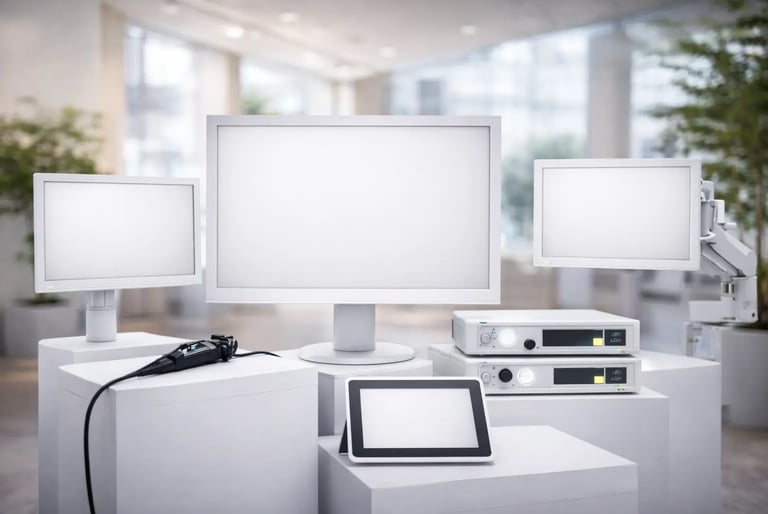
Selecting the right medical display for surgical environments is a decision that directly affects clinical outcomes. Surgeons rely on what they see on screen to guide every movement. A display that lacks brightness , distorts color or introduces lag compromises the visual information surgeons depend on. Choosing well means better visualization. Choosing poorly creates unnecessary risk.
This guide walks through the key specifications and considerations for selecting a medical display for operating rooms and endoscopy suites. Whether upgrading existing equipment or outfitting a new facility , understanding these factors helps ensure investments deliver genuine clinical value.
Why Medical Displays Differ from Consumer Monitors
It's tempting to assume any high-resolution display will work in a surgical setting. Consumer 4K monitors offer impressive specifications at attractive prices. But medical displays are engineered differently for reasons that matter clinically.
Regulatory Certification
A true medical display meets regulatory standards for use in patient care environments. In the US , this typically means FDA clearance as a Class I or Class II medical device. International markets have equivalent requirements. These certifications ensure devices meet safety standards for electrical isolation , electromagnetic compatibility and reliability.
Consumer monitors lack these certifications. Using uncertified displays for clinical decision-making creates regulatory compliance issues and potential liability exposure.
Environmental Durability
Operating rooms present harsh conditions for electronics. Bright surgical lighting creates glare. Fluids may splash. Aggressive cleaning chemicals are used repeatedly. Temperature and humidity fluctuate.
Medical displays are built to withstand these conditions. Sealed housings resist fluid ingress. Surfaces tolerate hospital-grade disinfectants. Anti-reflective coatings manage glare from surgical lights. Consumer monitors would fail quickly under similar conditions.
Consistent Performance
Clinical imaging requires consistent , calibrated performance. A surgical display must render colors accurately and maintain stable brightness throughout its service life. Variation in display characteristics could affect clinical interpretation.
Medical displays include features like backlight stabilization sensors , factory calibration and quality assurance modes that consumer products lack. These ensure the image today matches the image six months from now. Understanding advanced medical imaging technology helps contextualize why display consistency matters within the broader visualization chain.
Key Specifications for Surgical Displays
When evaluating a surgical display , several specifications deserve careful attention. Each affects how well the display serves its clinical purpose.
Resolution
Resolution determines how much detail a display can render. Higher resolution means more pixels and finer detail visibility.
For surgical applications , Full HD (1920 × 1080) represents the minimum acceptable standard today. This resolution matches most current HD camera systems and provides adequate detail for general surgical visualization.
4K resolution (3840 × 2160) offers four times the pixel count of Full HD. When paired with 4K cameras , a 4K surgical display reveals significantly finer anatomical detail. For procedures requiring maximum visual information , 4K provides meaningful clinical advantage.
The key is matching display resolution to camera output. A 4K display showing HD camera footage won't improve image quality. Conversely , an HD display receiving 4K signal discards detail the camera captured. System-level planning ensures components work together effectively.
Brightness
Operating rooms are bright environments. Surgical lights can produce intense illumination that washes out displays lacking sufficient brightness.
Medical displays for surgical use typically feature brightness levels of 500 cd/m² or higher. Some high-performance surgical displays exceed 800 cd/m². This high luminance ensures images remain visible and contrasty even under bright ambient lighting.
Brightness should be evaluated in context. A display destined for a dimly lit reading room needs less brightness than one positioned near surgical lights. Matching brightness to the intended environment optimizes both visibility and display longevity.
Color Accuracy
Surgical visualization depends on accurate color reproduction. Tissue differentiation often relies on subtle color differences. Healthy versus ischemic tissue. Arterial versus venous bleeding. Normal mucosa versus pathological change.
A surgical display that distorts color compromises the surgeon's ability to make these distinctions. Look for displays with wide color gamut coverage (expressed as percentage of sRGB , Adobe RGB or DCI-P3 standards) and factory calibration to ensure accurate reproduction.
According to the Radiological Society of North America , proper display calibration and quality assurance are fundamental to reliable medical imaging. While their guidance focuses primarily on diagnostic radiology , the principles apply equally to surgical visualization.
Viewing Angles
Multiple team members view surgical displays from various positions around the operating room. Unlike a personal monitor viewed straight-on , a surgical display must maintain image quality across wide viewing angles.
IPS (In-Plane Switching) panel technology provides superior viewing angles compared to older TN (Twisted Nematic) or VA (Vertical Alignment) panels. High-quality IPS panels maintain color accuracy and contrast even when viewed from 60 degrees or more off-axis.
Evaluate viewing angle specifications and , if possible , assess displays in person from the positions where surgical team members will actually view them.
Response Time and Latency
Surgical imaging is real-time imaging. Any delay between camera capture and display presentation affects hand-eye coordination. Surgeons need immediate visual feedback when moving instruments.
Response time measures how quickly pixels change state. Lower response times (measured in milliseconds) mean less motion blur during rapid movement. Look for response times below 10ms for surgical applications.
Input lag measures the total delay from signal input to image display. This encompasses all processing within the display. Surgical displays should minimize input lag to maintain the real-time feedback surgeons require.
Size
Medical display size affects both visibility and practical installation. Larger displays are easier to see from across the operating room. They accommodate multiple image sources in picture-by-picture configurations. But larger displays require more mounting space and may be impractical in constrained environments.
Common surgical display sizes range from 24 inches for near-patient viewing to 55 inches or larger for room-wide visibility. Consider viewing distances , mounting locations and whether single or multiple image sources will be displayed when selecting size.
Inputs and Connectivity
A surgical display must interface with various imaging sources. Endoscopic cameras , integration systems , PACS workstations and patient monitors may all need display connections.
Look for displays supporting multiple input types: SDI (3G-SDI or 12G-SDI for 4K) , HDMI , DisplayPort and potentially DVI for legacy equipment. Multiple inputs allow connection of several sources simultaneously , with switching between them as needed.
Some advanced surgical displays include built-in signal processing for picture-in-picture or picture-by-picture display of multiple sources. This integration simplifies system architecture by consolidating functions.
Hygienic Design Considerations
Infection control requirements shape medical display design in ways that affect selection decisions.
Sealed Enclosures
Surgical displays should feature sealed enclosures that prevent fluid and particulate ingress. IP (Ingress Protection) ratings indicate protection level. IP65 or higher indicates protection against water jets and dust , suitable for environments where fluid exposure may occur.
Cleanable Surfaces
Display surfaces must tolerate repeated cleaning with hospital-grade disinfectants. Glossy screens that streak or coatings that degrade under chemical exposure create hygiene and maintenance problems.
Look for displays with smooth , sealed bezels and chemical-resistant front surfaces designed for healthcare cleaning protocols.
Antimicrobial Features
Some medical displays incorporate antimicrobial coatings or materials that inhibit bacterial growth on surfaces. While not a substitute for proper cleaning , these features provide additional protection in infection-sensitive environments.
Mounting and Installation
How a surgical display mounts affects both usability and safety.
Mounting Options
Surgical displays typically mount on articulating arms attached to ceiling booms , wall mounts or equipment columns. The display's mounting interface (typically VESA standard) must be compatible with available mounting hardware.
Weight matters for arm-mounted installations. Heavier displays require more robust mounting systems and may limit positioning flexibility. Lighter displays offer more mounting options and easier repositioning.
Cable Management
Surgical environments require clean cable routing. Displays with rear-facing connections and integrated cable management facilitate tidy installations. Consider how cables will route from sources to the display when planning installations.
Positioning Flexibility
Surgeons need to position displays optimally for each procedure. Mounting systems should allow easy repositioning without tools. Displays should be viewable in both landscape and portrait orientations if clinical workflows require rotation.
When to Consider Advanced Surgical Display Features
Beyond basic specifications , some surgical displays offer advanced features worth considering for specific applications.
3D Visualization
Stereoscopic 3D displays add depth perception to surgical visualization. For procedures where depth information significantly aids performance , 3D capability provides genuine benefit.
Traditional 3D displays require special glasses , which can be cumbersome in surgical settings. Newer autostereoscopic technology , sometimes called "naked-eye 3D" , eliminates glasses by directing different images to each eye based on viewing position.
Naked-eye 3D medical grade monitors represent an emerging category offering stereoscopic visualization without eyewear. These displays suit applications where depth perception matters but glasses would be impractical. Options range from large-format 3D endoscope monitors for operating room use to portable 3D tablets for flexible deployment and specialized 3D microscope displays for microsurgical applications.
HDR (High Dynamic Range)
HDR displays reproduce a wider range of brightness levels than standard displays. This can improve visualization of both bright highlights and dark shadows within the same image.
HDR requires HDR-capable source content. As surgical cameras increasingly support HDR capture , HDR displays will offer corresponding benefits. Facilities investing in new displays may want HDR capability for future compatibility.
Touch Interaction
Some surgical displays incorporate touch screens for direct interaction with imaging systems. Touch capability can simplify control of image capture , annotation and system settings without requiring separate input devices.
Touch surfaces must meet the same hygienic requirements as non-touch displays , which adds complexity and cost.
Evaluating Total Cost of Ownership
Purchase price represents only part of medical display cost. Several factors affect total ownership expense.
Service and Warranty
Medical displays typically carry longer warranties than consumer products , reflecting their higher price and reliability requirements. Evaluate warranty terms and available service options. On-site service may be essential for displays critical to surgical operations.
Calibration Requirements
Some medical displays require periodic professional calibration to maintain performance. Others include self-calibration features that reduce ongoing maintenance needs. Factor calibration costs and requirements into ownership calculations.
Expected Lifespan
Quality medical displays typically operate reliably for 5-7 years or longer. Cheaper alternatives may fail sooner or degrade in performance. Dividing total cost by expected service years provides a better comparison than purchase price alone.
According to ECRI Institute , comprehensive evaluation of medical equipment should consider clinical performance , safety , total cost of ownership and vendor support capabilities. Display selection benefits from this holistic approach.
Partner With Suzhou Frank for Your Surgical Display Needs
Selecting the right medical display requires balancing specifications , budget and clinical requirements. Suzhou Frank Medical offers a comprehensive range of surgical visualization solutions designed for modern operating environments.
Our portfolio includes conventional 2D surgical displays in HD and 4K resolutions alongside innovative naked-eye 3D monitors that deliver stereoscopic visualization without glasses. From large-format OR displays to portable tablet configurations , we provide options for diverse clinical applications and facility requirements.
Our team understands the technical demands of surgical imaging and can help identify configurations that match your specific needs. Whether you're equipping a new surgical suite or upgrading existing visualization capabilities , we offer the expertise and product range to support your goals.
Contact us to discuss your surgical display requirements or explore our complete visualization product line.
Making Your Decision
Choosing a medical display for surgery involves balancing multiple factors. Resolution , brightness , color accuracy , viewing angles , connectivity and hygienic design all matter. No single specification determines suitability. The right display is one that meets clinical requirements within budget constraints while supporting long-term reliability.
Start by defining requirements based on actual clinical use. What cameras will feed the display? Where will it mount? Who needs to view it and from what positions? What environmental conditions must it withstand?
Then evaluate options against these requirements. Prioritize specifications that matter most for your applications. Don't pay for capabilities you won't use , but don't compromise on features that affect clinical performance.
A well-chosen surgical display serves reliably for years , supporting visualization that helps surgeons do their best work. That's an investment worth making thoughtfully.
© 2025. All rights reserved.
About Us
Introduction
Development
Cooperation
Service
Main Products
Medical Grade Monitor
No 15, Jinyang road KunshanSuzhou, Jiangsu, China