📞Customer Service: +86 13248368268 📧servicecenter@suzhoufrank.com one year replacement and warranty!

Innovative Medical Imaging: Trends Hospitals Should Watch
Where is innovative medical imaging heading? Key trends in visualization , integration and AI that hospital leaders should understand when planning investments.
MEDICAL IMAGING
Dr Qi Rui
12/31/20255 min read
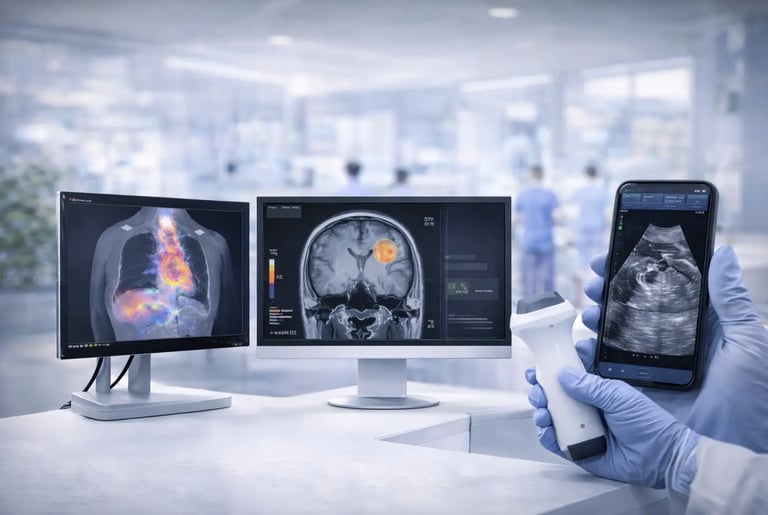
Medical imaging never stands still. What seemed cutting-edge five years ago now appears routine , while technologies once confined to research settings are entering clinical practice. For hospitals evaluating equipment investments and workflow improvements , understanding where innovative medical imaging is heading helps inform decisions that will shape care delivery for years to come.
This overview examines current trends transforming medical imaging , from visualization advances to integration improvements to emerging software capabilities. These developments affect not just image quality but workflow efficiency , educational opportunities and ultimately patient outcomes.
The Push Toward Higher Resolution
Resolution improvements continue driving innovative medical imaging forward. The transition from standard definition to high definition transformed surgical visualization. Now 4K resolution is becoming the expected standard , with 8K already appearing in specialized applications.
Why does resolution matter beyond sharper pictures? Higher resolution reveals subtle tissue differences , vascular details and pathological features that lower resolution systems obscure. Surgeons operating with 4K visualization report improved ability to identify tissue planes , detect small vessels and distinguish abnormal from normal tissue.
The Healthcare Information and Management Systems Society tracks digital health adoption including imaging technology. Their research shows facilities investing in higher-resolution systems report measurable improvements in procedural outcomes and reduced operative times. The initial equipment cost often recovers through efficiency gains and complication reduction.
Resolution advances extend beyond operating rooms. Diagnostic radiology workstations , pathology displays and even point-of-care imaging benefit from improved visual detail. Innovative medical imaging increasingly means seeing more clearly at every stage of the diagnostic and treatment pathway.
3D Visualization Without the Glasses
Three-dimensional imaging has existed for decades , but traditional approaches required special glasses or headsets that created barriers to adoption. Eye strain , inconvenience and compatibility issues limited 3D use despite its recognized benefits for depth perception.
Naked-eye 3D technology removes these obstacles. Modern autostereoscopic displays present three-dimensional images viewable without any eyewear. This seemingly simple change dramatically expands practical 3D applications in clinical settings.
Surgeons can glance at 3D displays during procedures without pausing to don glasses. Multiple observers can view simultaneously without sharing equipment. Extended viewing sessions become comfortable rather than fatiguing. The technology transforms 3D from an occasional specialty tool into a practical everyday capability.
Facilities exploring advanced medical imaging technology options now have access to naked-eye 3D across multiple form factors. Suzhou Frank Medical exemplifies this trend with their range of glasses-free 3D solutions including surgical monitors for operating rooms , portable tablets for bedside and procedural use , and microscope systems for pathology and laboratory applications. This comprehensive approach to 3D visualization represents where innovative medical imaging is heading: practical depth perception available wherever clinicians need it.
Integration Across Systems and Workflows
Standalone imaging equipment is giving way to integrated ecosystems. Modern hospitals expect imaging systems to communicate with electronic health records , PACS archives , surgical navigation platforms and quality reporting systems. Innovative medical imaging increasingly means connected imaging.
The Society for Imaging Informatics in Medicine publishes resources on imaging integration standards and best practices. Their work highlights how interoperability reduces duplicate data entry , prevents information silos and enables analytics across imaging encounters.
Integration benefits extend beyond administrative efficiency. When imaging findings flow automatically into clinical documentation , providers access complete information at decision points. When historical comparisons appear alongside current studies , radiologists interpret with full context. When imaging data feeds quality dashboards , departments identify improvement opportunities.
Hospitals evaluating new imaging equipment should assess integration capabilities alongside image quality. A system that produces excellent images but creates workflow friction or data isolation may deliver less overall value than a well-integrated alternative.
Artificial Intelligence as Clinical Support
AI in medical imaging has moved from research curiosity to clinical reality. Algorithms now assist with image acquisition , quality assessment , finding detection and quantitative measurement. And the applications keep expanding.
The World Health Organization has published guidance on AI regulation in healthcare , recognizing both the technology's potential and the need for appropriate oversight. Their framework emphasizes that AI should augment rather than replace clinical judgment.
Current AI applications in innovative medical imaging include automated detection of specific findings like pulmonary nodules or diabetic retinopathy , measurement tools that quantify tumor size or cardiac function consistently , and workflow tools that prioritize urgent studies for faster radiologist review.
These capabilities don't eliminate the need for skilled professionals. They reduce tedious tasks , catch findings that might be overlooked and provide quantitative consistency that supports longitudinal comparison. AI becomes a reliable assistant that makes human experts more effective.
Hospitals adopting AI-enhanced imaging should establish governance structures , validation processes and monitoring systems. The technology offers genuine benefits when implemented thoughtfully within appropriate clinical frameworks.
Portable and Point-of-Care Advances
Innovative medical imaging no longer requires patients to travel to imaging departments for every study. Portable ultrasound , mobile X-ray , handheld imaging devices and compact endoscopy systems bring visualization capabilities to wherever patients are.
Point-of-care imaging supports faster clinical decisions. Emergency physicians can confirm or rule out diagnoses immediately rather than waiting for department studies. Intensive care teams can monitor conditions without patient transport. Proceduralists can guide interventions with real-time imaging at the bedside.
Miniaturization hasn't meant sacrificing quality. Modern portable systems deliver image quality that rivals their department-based counterparts. The combination of portability and performance expands where and how imaging contributes to care.
This trend particularly benefits resource-limited settings , rural facilities and situations where patient transport poses risks. Innovative medical imaging becomes accessible imaging when technology travels to patients.
Enhanced Visualization Modes
Beyond resolution and dimensionality , imaging systems increasingly offer specialized visualization modes that reveal information standard imaging misses.
Narrow-band imaging in endoscopy enhances mucosal surface patterns and vascular structures , improving detection of early neoplasia. Fluorescence imaging identifies sentinel lymph nodes or confirms tissue perfusion. Contrast enhancement techniques in ultrasound and other modalities expand diagnostic capability.
These specialized modes don't replace standard imaging but complement it. Clinicians can switch between visualization approaches to answer different questions during the same procedure or examination. Innovative medical imaging means having multiple ways to see.
Educational and Training Applications
Advanced imaging supports teaching alongside clinical care. High-resolution recording captures procedural details for later review. Multiple display outputs allow trainees to observe what experienced practitioners see. 3D visualization helps learners understand spatial relationships that 2D images obscure.
Simulation and training platforms increasingly incorporate realistic imaging representations. Medical students and residents develop procedural skills with imaging guidance before approaching patients. This preparation improves performance and safety when trainees begin clinical work.
Facilities investing in innovative medical imaging should consider educational value alongside clinical utility. Equipment that supports teaching multiplies its impact across current and future practitioners.
Quality and Documentation Benefits
Modern imaging systems support quality improvement through comprehensive documentation. Automatic image capture , procedure recording , timestamped annotations and structured reporting create records that enable meaningful quality review.
When complications occur , detailed imaging records support root cause analysis. When outcomes excel , documentation demonstrates what practices contributed. This feedback loop drives continuous improvement that benefits patients.
Regulatory and accreditation requirements increasingly expect robust imaging documentation. Investing in systems with strong documentation capabilities positions facilities for evolving compliance expectations.
Preparing for What's Next
Technology will continue advancing. Hospitals that establish flexible infrastructure , maintain integration standards and cultivate staff adaptability will incorporate future innovations more readily than those locked into rigid systems.
The trends outlined here , higher resolution , glasses-free 3D , system integration , AI assistance , portability , specialized visualization , educational applications and quality documentation , represent current directions rather than final destinations. Innovative medical imaging will keep evolving.
Providers like Suzhou Frank Medical who stay current with these trends offer hospitals partnership in ongoing advancement rather than just equipment sales. Evaluating vendors on their innovation trajectory alongside their current products helps ensure long-term alignment.
Conclusion
Innovative medical imaging encompasses far more than incremental resolution improvements. The field is transforming how clinicians visualize , integrate , analyze and document imaging information across care settings. Hospitals that understand these trends can make investment and workflow decisions that position them for both current excellence and future advancement.
© 2025. All rights reserved.
About Us
Introduction
Development
Cooperation
Service
Main Products
Medical Grade Monitor
No 15, Jinyang road KunshanSuzhou, Jiangsu, China