📞Customer Service: +86 13248368268 📧servicecenter@suzhoufrank.com one year replacement and warranty!

What Is a Medical-Grade Monitor? Key Features and Buying Guide
Choosing a medical monitor? Understand what makes displays medical-grade , key features to evaluate and how to select the right one for your clinical needs.
MEDICAL IMAGING
Dr Qi Rui
12/28/20257 min read
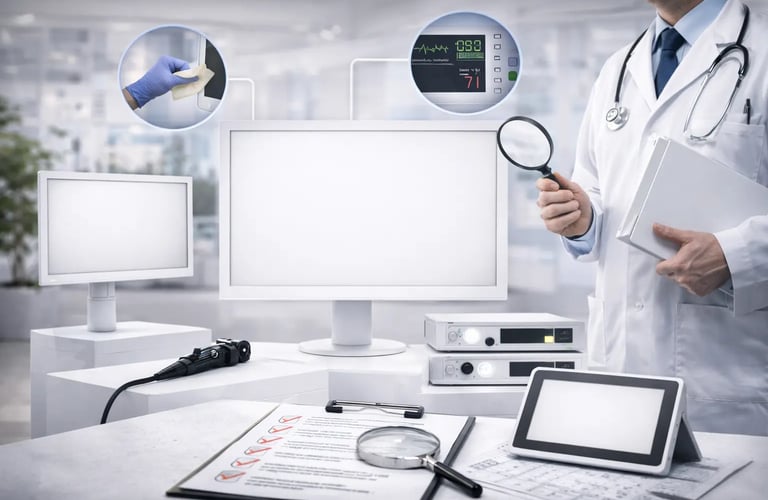
A medical-grade monitor is a display specifically designed , manufactured and certified for use in clinical environments where image quality directly affects patient care. These monitors differ from consumer displays in ways that matter for diagnosis , surgical visualization and clinical decision-making.
Understanding what makes a medical monitor different from standard commercial screens helps healthcare facilities make informed purchasing decisions. This guide defines medical-grade monitors , explains their distinguishing features and provides practical guidance for evaluation and selection.
Defining Medical-Grade Monitors
The term "medical-grade monitor" refers to displays that meet regulatory standards for use in healthcare settings. These aren't simply high-quality consumer monitors repurposed for clinical use. They're purpose-built devices designed to meet the unique demands of medical imaging.
What distinguishes a medical monitor from a consumer display? Several factors combine to earn the medical-grade designation.
Regulatory Compliance
A true medical-grade monitor carries regulatory clearance as a medical device. In the United States , this means FDA clearance under 21 CFR Part 820 quality system regulations. The U.S. Food and Drug Administration classifies medical displays as Class I or Class II medical devices depending on their intended use.
International markets have equivalent requirements. The EU Medical Device Regulation (MDR) , Health Canada licensing and other national frameworks impose similar standards. These regulations ensure medical monitors meet safety , performance and quality requirements appropriate for patient care environments.
Consumer monitors lack these certifications. Using non-certified displays for clinical imaging creates compliance issues and potential liability exposure. When patient outcomes depend on what clinicians see on screen , regulatory compliance isn't optional.
Designed for Clinical Environments
Medical-grade monitors are engineered for conditions that would quickly degrade consumer displays. Hospital environments present unique challenges: aggressive cleaning chemicals , potential fluid exposure , 24/7 operation , bright ambient lighting and electromagnetic interference from other equipment.
Medical monitors address these challenges through sealed enclosures , chemical-resistant surfaces , robust power supplies and shielding against electromagnetic interference. They're built to maintain performance over years of demanding clinical use.
Key Features of Medical-Grade Monitors
Several technical features distinguish medical monitors from consumer alternatives. Understanding these features helps facilities evaluate options and select appropriate displays for specific applications.
Calibration and DICOM Compliance
Perhaps the most important feature of a medical-grade monitor is calibrated grayscale performance. Diagnostic imaging depends on accurate display of subtle density differences. A monitor that can't render these differences accurately compromises diagnostic capability.
The DICOM (Digital Imaging and Communications in Medicine) standard includes a Grayscale Standard Display Function (GSDF) that defines how monitors should render grayscale values. DICOM-calibrated medical monitors conform to this standard , ensuring consistent grayscale reproduction that matches what image acquisition systems intended.
According to the American Association of Physicists in Medicine , proper display calibration and quality control are essential for accurate medical image interpretation. Their Task Group 18 report provides comprehensive guidance on display performance assessment that informs medical monitor standards.
Calibration isn't a one-time event. Medical-grade monitors include tools for ongoing calibration maintenance. Some feature integrated sensors that automatically verify and adjust performance. Others require periodic manual calibration using external measurement devices. Either approach ensures displays maintain accurate performance throughout their service life.
Brightness and Stability
Medical monitors require higher brightness than consumer displays , particularly for environments with ambient lighting. Diagnostic monitors typically operate at 350-500 cd/m² or higher. Surgical displays may exceed 700 cd/m² to remain visible under bright operating room lights.
More importantly , medical monitors maintain stable brightness over time. Consumer displays may lose 50% of their brightness within a few years. Medical-grade monitors are designed to maintain calibrated luminance throughout their rated lifespan , often 5-7 years or longer.
Backlight stabilization technology automatically adjusts power to maintain consistent brightness as components age. This ensures the display today performs the same as the display years from now , critical for consistent clinical interpretation.
Resolution and Image Quality
Medical monitors are available across a range of resolutions matched to clinical applications. Diagnostic radiology displays typically offer 2-5 megapixels for general imaging or 5-12 megapixels for mammography. Surgical and endoscopy monitors commonly provide Full HD or 4K resolution.
Beyond pixel count , medical-grade monitors deliver superior image quality through higher bit depth (enabling more grayscale levels) , wider color gamuts and better contrast ratios than consumer alternatives. These specifications translate to more accurate , detailed images that support clinical decision-making.
Understanding how medical monitors fit within advanced medical imaging technology systems helps facilities appreciate why display quality matters for overall imaging chain performance.
Viewing Angles
Clinical environments often require multiple people to view the same display from different positions. Radiologists may collaborate on cases. Surgical teams view monitors from various angles around the operating table.
Medical-grade monitors use high-quality IPS or similar panel technologies that maintain color accuracy and contrast across wide viewing angles. Images remain accurate whether viewed straight-on or from significant off-axis positions. Consumer displays often show significant color shift and contrast loss when viewed from angles , making them unsuitable for collaborative clinical viewing.
Hygienic Design
Infection control requirements shape medical monitor design. Clinical environments demand regular cleaning with hospital-grade disinfectants that would damage consumer displays.
Medical monitors feature sealed enclosures that prevent fluid and particulate ingress. Front surfaces are designed to withstand repeated chemical cleaning without degradation. Bezels are smooth and sealed , eliminating crevices where contaminants could accumulate.
Some medical-grade monitors incorporate antimicrobial materials or coatings that inhibit bacterial growth on surfaces. While not replacing proper cleaning protocols , these features provide additional protection in infection-sensitive environments.
Types of Medical-Grade Monitors
Medical monitors serve different clinical applications , each with distinct requirements.
Diagnostic Displays
Diagnostic monitors are used for primary image interpretation in radiology. They offer the highest resolution and most precise calibration , optimized for detecting subtle pathology in medical images. Mammography displays represent the most demanding category , requiring extremely high resolution and precise grayscale performance.
Clinical Review Displays
Clinical review monitors serve physicians who need to view images but aren't performing primary diagnosis. These displays offer good image quality at more moderate specifications and price points. They're common in physician offices , nursing stations and clinical consultation areas.
Surgical Displays
Surgical monitors are designed for operating room environments. They prioritize brightness , viewing angles and durability over the extreme grayscale precision of diagnostic displays. Real-time video from endoscopic cameras and other surgical imaging devices is their primary content.
Specialty Displays
Certain applications require specialized medical monitors. Dental imaging displays are sized and specified for dental practice needs. Pathology monitors support digital pathology workflows with specific color and resolution requirements. Naked-eye 3D medical grade monitors provide stereoscopic visualization without glasses for surgical and endoscopic applications where depth perception enhances clinical performance.
Practical Buying Considerations
Selecting the right medical-grade monitor requires matching specifications to clinical needs while considering practical factors that affect long-term value.
Match Specifications to Application
Different clinical applications demand different monitor specifications. A mammography workstation requires different capabilities than an OR display. Define the intended use first , then select monitors with appropriate specifications.
Over-specifying wastes money on capabilities you don't need. Under-specifying compromises clinical performance. Understanding your application requirements guides appropriate selection.
Evaluate Total Cost of Ownership
Purchase price represents only part of medical monitor cost. Consider warranty terms , service availability , calibration requirements and expected lifespan when comparing options.
A medical-grade monitor costing twice as much as a consumer alternative but lasting three times longer while meeting clinical requirements may offer better value. Calculate cost per year of useful service for meaningful comparison.
Consider Vendor Support
Medical monitor performance depends on ongoing support. Calibration services , replacement parts , firmware updates and technical assistance all matter over a display's service life.
Evaluate vendor reputation , support infrastructure and commitment to the medical market. Established vendors with dedicated healthcare divisions typically offer more reliable long-term support than companies treating medical monitors as a sideline.
Plan for Integration
Medical monitors must integrate with existing infrastructure. Verify compatibility with your PACS , imaging equipment and IT systems. Confirm that connectivity options match your requirements. Consider how new monitors will fit within existing mounting hardware and room layouts.
Verify Compliance
Confirm that any medical monitor under consideration carries appropriate regulatory clearances for your jurisdiction and intended use. Request documentation of FDA clearance , CE marking or other applicable certifications. Don't rely on marketing claims alone.
Advanced Features Worth Considering
Beyond baseline requirements , some medical-grade monitors offer advanced features that may benefit specific applications.
Integrated Calibration Sensors
Monitors with built-in calibration sensors can automatically verify and maintain performance without external equipment or service visits. This simplifies quality assurance and ensures consistent calibration.
3D Visualization
For surgical and endoscopic applications , 3D-capable medical monitors add depth perception that can enhance procedural performance. Options include glasses-based 3D systems and newer naked-eye 3D technology.
Products like 3D endoscope monitors and 3D medical tablets deliver stereoscopic visualization without special eyewear. 3D microscope displays bring depth perception to microsurgical applications. These specialized medical monitors suit facilities where 3D visualization provides clinical advantage.
Multi-Input Capability
Medical monitors supporting multiple inputs can display content from several sources or switch between sources as needed. This flexibility suits environments where different imaging systems share display resources.
Touch Interaction
Touch-enabled medical monitors allow direct screen interaction for image manipulation or system control. Touch capability must be implemented with cleanable surfaces suitable for clinical environments.
Why Medical-Grade Matters
The choice between a true medical-grade monitor and a consumer alternative isn't just about specifications. It's about patient safety , regulatory compliance and long-term reliability.
Consumer displays may offer impressive specs on paper at lower prices. But they lack the calibration precision , environmental durability , regulatory certification and quality assurance that medical monitors provide. These differences matter when clinical decisions depend on what appears on screen.
Facilities that invest in proper medical-grade monitors invest in reliable visualization that supports accurate diagnosis and safe procedures. That investment pays dividends in clinical performance , regulatory compliance and equipment longevity.
Partner With Suzhou Frank for Medical Monitor Solutions
Selecting the right medical-grade monitor requires understanding both clinical requirements and available technology options. Suzhou Frank Medical offers a comprehensive range of medical monitors designed for diverse healthcare applications.
Our portfolio includes conventional diagnostic and clinical review displays alongside innovative naked-eye 3D monitors that deliver stereoscopic visualization without glasses. From large-format surgical displays to portable tablet configurations , we provide solutions for operating rooms , endoscopy suites , diagnostic imaging departments and clinical review environments.
With expertise in medical display technology and commitment to quality , we help facilities identify monitors that match their specific clinical needs and budget requirements.
Contact us to discuss your medical monitor requirements and discover how our solutions can enhance your clinical visualization capabilities.
© 2025. All rights reserved.
About Us
Introduction
Development
Cooperation
Service
Main Products
Medical Grade Monitor
No 15, Jinyang road KunshanSuzhou, Jiangsu, China