📞Customer Service: +86 13248368268 📧servicecenter@suzhoufrank.com one year replacement and warranty!

GI Training with Simulators: Structuring a Program
From basic scope navigation to advanced therapeutic procedures, simulators can be structured to support the full GI training journey. Here is how to build a program that works.
MEDICAL TRAINING
Dr Qi Rui
3/18/20268 min read
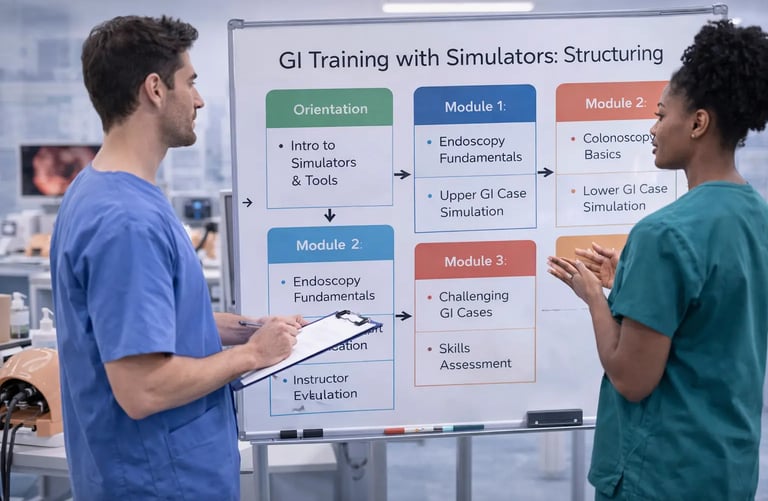
Gastrointestinal endoscopy is a high-volume, high-stakes specialty. Colonoscopy, upper endoscopy, and increasingly complex therapeutic procedures like EMR and ESD are performed by the millions every year across the world. The technical demands are real: a trainee must learn to navigate a flexible scope through tortuous anatomy, identify and classify lesions, manage loops, and perform interventions, all while maintaining patient comfort and safety.
Building those skills takes time, volume, and structure. Simulation has become an essential part of that process. Not because it replaces supervised clinical experience, but because it provides something clinical training alone cannot: a controlled environment for deliberate practice, objective measurement of progress, and the ability to expose every trainee to a defined, standardized set of cases and skills before they arrive in a real endoscopy suite.
This article is about how to structure a GI training program that uses simulators effectively, from initial orientation to clinical readiness.
Why Simulation Belongs in GI Training
The traditional model of GI training, watch a senior perform procedures, then attempt them under supervision with increasing independence, remains the foundation of clinical competency development. Nothing fully replaces supervised patient exposure. But that model has well-documented limitations when used alone.
Clinical training is inherently opportunistic. The cases a trainee encounters depend on what comes through the endoscopy suite that day. A trainee may see twenty straightforward colonoscopies before encountering a difficult sigmoid anatomy. They may spend weeks without performing a polypectomy on a challenging flat lesion. The variability of clinical exposure is difficult to control, and it means that trainees may graduate from training programs with significant gaps in their technical experience.
Simulation addresses this directly. A simulator can be programmed to present any case type, any anatomy, any pathology, on demand and as many times as needed. Every trainee in a program can be exposed to the same set of experiences regardless of clinical volume fluctuations. This standardization of training exposure is one of the most powerful arguments for integrating simulation into GI curricula.
Beyond standardization, simulation offers a practice environment where errors are formative rather than consequential. A trainee who struggles with sigmoid loop management on a simulator learns from that struggle without causing patient discomfort. A trainee who misjudges snare placement during polypectomy on a model can analyze what went wrong and try again immediately. This kind of deliberate practice with rapid feedback is central to the evidence base for simulation in medical education, as extensively documented through PubMed.
The Components of a Structured GI Simulation Program
A well-designed GI simulation program is more than a collection of simulators available in a room. It is a structured curriculum with defined learning objectives, progression criteria, assessment methods, and integration with clinical training. The following components are essential.
1. Defined Learning Objectives by Stage
Before selecting simulators or designing sessions, the program needs to define what it is trying to achieve, and at what stage. GI training covers a wide range of skills, from basic scope navigation to advanced therapeutic procedures, and the simulation tools appropriate for each stage differ.
A typical progression might look like this:
At the foundation stage, the objective is scope handling, basic navigation, and air/water management. Physical bench-top models or entry-level simulators are the right tool here because they let trainees focus entirely on instrument mechanics without cognitive overload. At the intermediate stage, the focus shifts to full colonoscopy navigation and basic upper endoscopy, which a full GI simulator can support with structured case progression and automated feedback. For skill-specific development, tasks like polypectomy, injection, and clipping are best practiced on dedicated task trainers that isolate each technique. Advanced procedures including EMR, ESD, and other therapeutic interventions require ESD simulators or ex-vivo tissue models that replicate mucosal layers realistically. Finally, at the integration stage, trainees practice managing complete procedures with realistic pathology cases using a full simulator with a broad case library.
Mapping learning objectives to simulation tools at each stage ensures that training resources are used efficiently and that learners are challenged appropriately rather than under- or over-challenged.
2. Simulator Selection
The simulators chosen for a program should match the learning objectives defined above. This is a point that is worth emphasizing because programs sometimes invest in high-end simulators for foundational skills that could be equally well addressed with less expensive equipment, while overlooking the specific tools needed for the advanced skills that are hardest to acquire clinically.
For a GI training program, a reasonable core setup typically includes:
Physical models for navigation and basic technique: A bench-top model that replicates the basic anatomy of the stomach, duodenum, and colon, compatible with standard flexible endoscopes. This is where foundational scope handling skills are developed.
Task trainers for specific interventions: Dedicated models for polypectomy, injection, clipping, and hemostasis, used for focused skill practice at the intermediate stage.
Advanced tissue models: For programs training fellows in ESD or EMR, a tissue model that replicates the layered structure of GI mucosa allows safe practice of the dissection technique. The GI ESD Surgical Simulator is designed specifically for this purpose, providing the tissue environment needed to develop and rehearse ESD technique before clinical application.
Full GI endoscopy simulation platform: For integration training and assessment, a full-scope simulator with case variety and performance metrics supports the later stages of the curriculum.
The GI Endoscopy Simulator provides a physical platform for both upper and lower GI navigation practice, bridging basic orientation and more advanced case-based training.
3. Scheduling and Time Allocation
Simulation only works if learners use it. This sounds obvious, but it requires deliberate scheduling. In busy clinical environments, simulation sessions are easily deprioritized in favor of clinical commitments. Programs need to protect simulation time in the way they protect clinic time or procedure lists.
Best practices for scheduling include:
Dedicated simulation sessions at the beginning of training rotations, before clinical volume increases
Regular short sessions (30–60 minutes) for task trainer practice throughout training, rather than infrequent long sessions
Self-directed access to simulators outside of scheduled sessions to allow additional repetitions
Mandatory simulation milestones before progression to the next clinical stage
Programs that treat simulation as optional tend to find that learners who are already performing well in the clinic simply do not use it, while learners who most need additional practice do not either. Making simulation a required, assessed component of training changes this dynamic.
4. Assessment and Progress Tracking
Assessment is what separates a structured simulation program from unstructured time on a simulator. The goal of assessment in simulation is not to generate grades, it is to identify where each trainee is in their skill development and what they need to focus on next.
Effective assessment in GI simulation programs includes:
Structured observation checklists: Instructors observe trainees performing specific procedures on the simulator and rate performance against defined criteria, scope handling, loop management, lesion detection rate, withdrawal time, intervention accuracy.
Simulator-generated metrics: Many simulators record objective data, time to cecum, number of loops formed, force applied, mucosal visualization percentage. These metrics provide a performance baseline and track improvement over time.
Video review: Recording simulation sessions and reviewing them with trainees accelerates learning by allowing detailed, visual feedback on technique.
Milestone assessments: At defined points in the curriculum, trainees complete formal assessments on the simulator that must meet minimum performance standards before they progress to the next stage.
A framework for connecting assessment tools to competency criteria is outlined in skills assessment in simulation, which covers both the instruments used and the standards against which performance is measured.
5. Integration with Clinical Training
Simulation training is most effective when it is directly integrated with clinical exposure rather than treated as a separate track. This means that simulation sessions should be timed to prepare trainees for what they are about to do in the endoscopy suite, and debrief sessions should explicitly connect simulation performance to clinical experience.
For example:
A trainee preparing for their first supervised colonoscopy completes a navigation session on the simulator the week before
A trainee who had difficulty with a polypectomy during a supervised case works through a polypectomy task trainer session the following day
A fellow approaching their first supervised ESD case completes several tissue model sessions beforehand
This tight coupling between simulation and clinical training makes simulation feel relevant to trainees and reinforces the transfer of skills from the simulated to the clinical environment.
Structuring Practice Time Effectively
Given limited time and resources, how simulation time is used matters as much as how much simulation time is available.
Focus on Specific Weaknesses
Trainees should not spend simulation time practicing what they are already good at. Before each simulation session, the instructor and trainee should identify the specific skill gap or learning objective for that session. Assessment data from previous sessions and clinical feedback from supervisors are both useful inputs for this planning.
Use Difficulty Progression
Start with easier cases and anatomies and progressively increase difficulty as skills develop. On task trainers, this might mean starting with large pedunculated polyps before moving to small flat sessile lesions. On navigation simulators, it might mean starting with straightforward anatomy before working through cases with challenging looping.
Ensure Active, Not Passive, Practice
Observation alone does not build procedural skill. Trainees should be performing, not watching. In group simulation sessions, minimize the time any trainee spends waiting to use the simulator by planning structured rotations.
Build in Debrief Time
Every simulation session should end with a brief review of what was practiced, what went well, and what to work on next. Even five minutes of structured reflection accelerates learning considerably compared to ending the session at the simulator without any consolidation.
GI Training Programs: International Context
GI endoscopy training requirements vary by country and by specialty society, but simulation integration is increasingly standard in major training frameworks globally. The World Health Organization recognizes simulation as a core patient safety strategy, and leading GI societies in Europe, North America, and Asia-Pacific have all published guidelines recommending simulation-based training as part of endoscopy curricula.
For programs building or revising their simulation curriculum, the approach detailed in simulation curriculum endoscopy provides a structured framework for developing a program that meets contemporary training standards.
Common Challenges and How to Address Them
"We don't have the budget for high-end simulators."
Not all effective simulation requires expensive equipment. Physical bench-top models are much more affordable than high-fidelity VR platforms and are highly effective for foundational navigation and task trainer practice. Programs should prioritize the simulation tools that address their most critical training gaps first.
"Trainees don't find simulation time valuable."
This is usually a sign that the simulation program is not well-integrated with clinical training and assessment. When simulation sessions are tied to specific clinical objectives and performance is measured and fed back, trainees quickly recognize the practical value. Connecting simulation metrics to clinical progression criteria also increases engagement.
"We don't have dedicated simulation faculty."
Simulation sessions do not always require a faculty member present in the room. Self-directed simulation with structured objectives and a checklist for self-assessment can be effective for many foundational skills. Faculty time is best invested in assessment sessions and debrief, rather than passive supervision.
SuzhouFrank: Supporting GI Training Programs with Physical Simulators
SuzhouFrank manufactures a range of physical simulation models designed for GI and endoscopy training programs, from foundational navigation models to advanced tissue trainers for ESD and therapeutic procedures. Their equipment is used in hospital training departments, endoscopy training centers, and medical schools across multiple countries.
For programs building or expanding a GI simulation curriculum, the full catalogue is available at https://www.suzhoufrank.com/all-products#endoscopic-intervention-training-model. The team can be reached directly for product questions or institutional inquiries through the contact page.
Conclusion
GI training with simulators works when it is structured deliberately. Defined learning objectives, appropriately selected simulation tools, protected practice time, objective assessment, and tight integration with clinical training are the components that turn a collection of simulators into an effective training program.
The result is trainees who arrive at real patient procedures with genuine technical competency, having practiced the specific skills they need, in the specific anatomical environments they will encounter, often enough to perform with confidence. For a specialty where precision directly affects patient outcomes, that preparation is not a luxury. It is what rigorous training looks like.
© 2025. All rights reserved.
About Us
Introduction
Development
Cooperation
Service
Main Products
Medical Grade Monitor
No 15, Jinyang road KunshanSuzhou, Jiangsu, China