📞Customer Service: +86 13248368268 📧servicecenter@suzhoufrank.com one year replacement and warranty!

Colonoscopy Training: Simulation-Based Path to Competence
Reaching colonoscopy competence takes deliberate, structured practice. Discover how simulation-based training programs design progressive curricula that prepare trainees for real clinical cases.
MEDICAL TRAINING
Dr Qi Rui
3/24/20266 min read
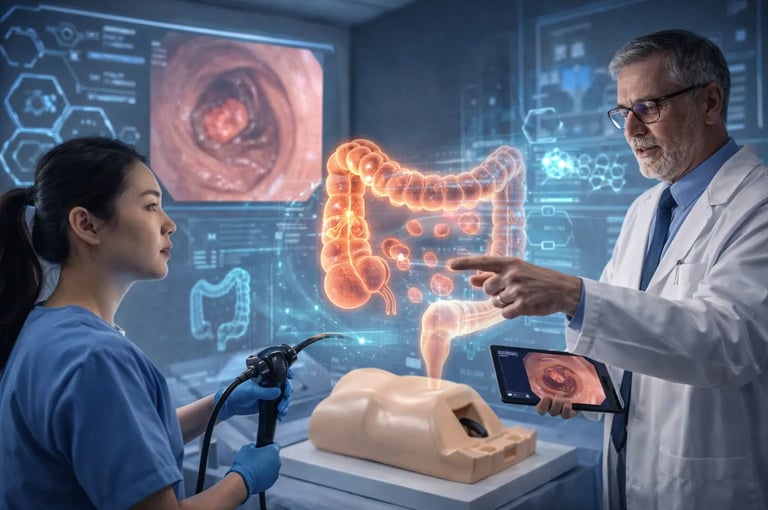
Colonoscopy is the gold standard for colorectal cancer screening and the most frequently performed lower GI endoscopic procedure worldwide. Its importance to public health is difficult to overstimate: colorectal cancer is the third most diagnosed cancer globally, and colonoscopy with polypectomy has been shown to reduce both incidence and mortality when performed by trained, competent endoscopists. Yet colonoscopy is also among the most technically demanding procedures in gastroenterology, a fact that traditional training methods have not always adequately addressed.
The shift toward simulation-based colonoscopy training reflects a growing recognition that competence cannot be assumed after a fixed number of supervised cases. It must be demonstrated, measured, and reinforced through structured practice. Simulation provides the infrastructure to make that possible.
The Technical Demands of Colonoscopy
Colonoscopy requires a unique combination of manual dexterity, spatial reasoning, and clinical judgment. The colon is a long, mobile, anatomically variable organ, and the path from the rectum to the cecum is rarely straight. Trainees must learn to navigate acute angulations, manage looping, and maintain forward progress without excessive force, all while monitoring the mucosal surface for subtle lesions.
Why the Learning Curve Is Long
Research consistently shows that the number of supervised colonoscopies required to achieve competence is higher than previously assumed. Early studies suggested competence by 100 to 200 cases; more recent data suggest many trainees require 300 or more to achieve reliable cecal intubation rates and adequate adenoma detection rates. This long learning curve has direct implications for patient safety, program capacity, and trainee stress.
The technical challenges that extend the learning curve include:
Loop formation and reduction: Managing sigmoid and transverse loops requires counter-intuitive maneuvers that are difficult to learn on patients.
Cecal intubation under time pressure: Completing the procedure efficiently without compromising mucosal inspection demands simultaneous skill across multiple dimensions.
Polyp detection: Adenoma detection rate (ADR) is a key quality metric, and training programs must develop both the technical and perceptual skills needed for consistent lesion identification.
How Simulation Shortens the Learning Curve
Simulation addresses the most challenging aspects of colonoscopy training by providing a safe, controllable environment for deliberate practice. Unlike supervised patient cases, simulation allows trainees to encounter and manage specific technical challenges, such as alpha loop formation or acute splenic flexure angulation, on demand, without waiting for clinical cases that happen to present those challenges.
Deliberate Practice in Colonoscopy Simulation
Deliberate practice is a pedagogical concept that emphasizes focused, structured repetition of specific skills with immediate feedback. Simulation is the ideal platform for deliberate practice in colonoscopy because:
Specific anatomy can be selected or programmed
The same scenario can be repeated until mastery is achieved
Feedback on performance (intubation time, patient discomfort, loop formation) is immediate
Practice can occur outside clinical hours, maximizing total training time
For a detailed overview of how simulators support the broader endoscopy training landscape, see What Is an Endoscopy Simulator?, which explains the different simulator categories and their respective strengths in procedural training.
Stages of Simulation-Based Colonoscopy Training
A well-structured simulation-based colonoscopy curriculum progresses through defined stages, each building on the previous.
Stage 1: Instrument Familiarization
Before attempting to navigate the colon, trainees must understand the colonoscope as an instrument. This includes:
Holding and balancing the control section
Using the two control dials for up/down and left/right deflection
Coordinating tip deflection with shaft rotation (torque)
Operating the suction, irrigation, and air/water channels
Physical models and box trainers are particularly effective at this stage because they allow trainees to use real instruments and develop genuine tactile familiarity.
Stage 2: Segment-by-Segment Navigation
Rather than attempting a full colonoscopy immediately, trainees benefit from practicing individual segments in isolation. Common practice targets include:
Rectal insertion and rectosigmoid negotiation
Sigmoid colon navigation and loop management
Splenic flexure passage
Transverse colon traversal
Hepatic flexure and cecal intubation
Breaking the procedure into segments allows trainees to master each before combining them. This staged approach significantly reduces cognitive overload compared to attempting unsupported full-procedure practice from the outset.
Stage 3: Full Procedure Integration
Once individual segments are mastered, trainees progress to full-procedure simulation, including:
Complete insertion to cecum
Systematic withdrawal and mucosal inspection
Recognition and documentation of pathology
Basic therapeutic maneuvers (biopsy, polypectomy preparation)
At this stage, performance metrics such as cecal intubation rate, withdrawal time, and polyp detection rate become meaningful assessment targets.
Stage 4: Supervised Clinical Transition
Trainees who complete structured simulator training are better prepared for their first supervised patient colonoscopies. The transition is smoother because they have already internalized basic loop management and navigation strategies. Supervisors can focus coaching on patient communication, complex pathology, and advanced therapeutic decision-making.
Objective Assessment in Colonoscopy Training
One of simulation's most important contributions to colonoscopy training is the ability to generate objective performance data. Traditional apprenticeship training relies heavily on supervisor impressions, which are inherently subjective. Simulation platforms can quantify performance across multiple dimensions simultaneously.
Key Colonoscopy Performance Metrics
Cecal intubation rate (CIR): The percentage of procedures in which the cecum is reached. A CIR above 90% is the standard of competence for independent practice.
Cecal intubation time (CIT): The time taken to reach the cecum. Efficiency is a proxy for technical skill and patient comfort.
Patient discomfort score: An estimate of patient pain or discomfort during the procedure, derived from the amount of force applied and loop formation events.
Mucosal visualization score: The proportion of mucosal surface adequately visualized during withdrawal.
Adenoma detection rate (ADR): The percentage of screening colonoscopies in which at least one adenoma is found. ADR is the most important quality metric in clinical colonoscopy and has direct implications for patient outcomes.
These metrics can be tracked across simulation sessions and clinical cases to build a longitudinal picture of trainee progress. For a comprehensive discussion of how assessment tools are applied in simulation-based endoscopy training, see Skills Assessment in Simulation.
Physical Models vs. Virtual Reality Simulators in Colonoscopy Training
Both physical colonoscopy models and VR simulators have important roles in training, and the best programs use both strategically.
Physical Colonoscopy Models
Physical models use rigid or flexible anatomical replicas of the colon to provide realistic tactile feedback. They require real colonoscopes and accessories, making them ideal for instrument familiarization, insertion technique practice, and accessory skill training (biopsy, polypectomy). They are low-cost per session, durable, and do not require computer infrastructure.
Virtual Reality Simulators
VR colonoscopy simulators generate computerized anatomical environments with haptic feedback and automated performance assessment. They excel at scenario training, pathology recognition, and objective metrics generation. They can simulate a wide range of patient anatomies, including challenging cases with redundant colons or acute angulations.
The GI Endoscopy Simulator from SuzhouFrank provides a high-quality physical training platform suitable for both initial colonoscopy skill development and ongoing competency maintenance. Its realistic tissue texture and anatomical proportions support meaningful practice of insertion, navigation, and withdrawal techniques.
Evidence Supporting Simulation-Based Colonoscopy Training
The evidence base for simulation in colonoscopy training is robust. Multiple randomized controlled trials and systematic reviews have demonstrated that simulator-trained trainees perform better in early clinical cases compared to controls.
A systematic review published on PubMed concluded that simulation-based training significantly improves colonoscopy performance in terms of cecal intubation rate and patient comfort, particularly in the early stages of training. The effect size was most pronounced when simulation was integrated into a structured curriculum rather than used as a standalone experience.
The World Health Organization's patient safety framework emphasizes the importance of structured competency-based training in procedural medicine, and simulation-based colonoscopy training aligns directly with these principles. See WHO Patient Safety for the broader policy context.
Colonoscopy Simulation in Competency-Based Medical Education
Modern medical education is increasingly organized around competency-based frameworks rather than time-in-training. In gastroenterology, this means trainees must demonstrate measurable proficiency before advancing to unsupervised practice. Simulation is the most practical mechanism for delivering and assessing competency at scale.
A simulation-integrated colonoscopy training program typically defines:
Minimum simulator performance thresholds before first supervised patient case
Minimum supervised case volumes before independent practice
Ongoing assessment intervals throughout training
Remediation pathways for trainees who plateau
For a deeper exploration of how competency frameworks apply specifically to endoscopy training, see Competency Training in Endoscopy, which covers the key performance standards and assessment tools used in contemporary programs.
SuzhouFrank: Physical Simulation Solutions for Colonoscopy Training
SuzhouFrank designs and manufactures medical simulation equipment for endoscopy training programs worldwide. Our colonoscopy training models are built for durability, anatomical realism, and practical usability in both classroom and skills lab settings.
Whether you are building a new colonoscopy training curriculum or expanding an existing program, our product catalogue at https://www.suzhoufrank.com/all-products#endoscopic-intervention-training-model includes a range of options suited to different training objectives and budget profiles. For direct inquiries, demonstrations, or institutional pricing, contact us at https://www.suzhoufrank.com/contact-us.
Conclusion
Colonoscopy training has always been demanding, but the tools available to support that training have never been better. Simulation-based approaches, combining physical models for tactile skill development with VR platforms for scenario training and assessment, provide a coherent, evidence-supported pathway from novice to competent colonoscopist. Programs that integrate simulation systematically into their curricula produce safer trainees, protect patients during skill acquisition, and deliver more consistent educational outcomes across their cohorts. For institutions committed to colorectal cancer prevention through high-quality colonoscopy, investing in simulation infrastructure is not optional, it is foundational.
References:
© 2025. All rights reserved.
About Us
Introduction
Development
Cooperation
Service
Main Products
Medical Grade Monitor
No 15, Jinyang road KunshanSuzhou, Jiangsu, China